Somebody on your team already spends part of every week learning to manage AI agents. Most likely, nobody gave them that job, nobody counts the hours, and nobody reviews the result.
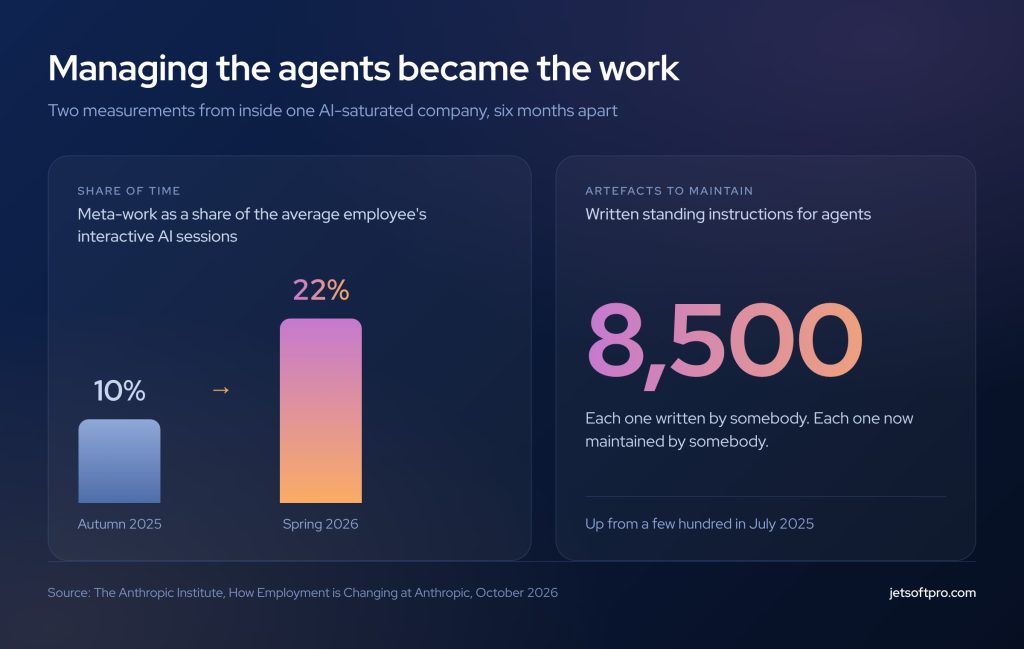
Here is the clearest evidence that this is now real work. At Anthropic, written standing instructions for agents grew from a few hundred in July 2025 to 8,500 a year later. That is 8,500 documents telling agents how to behave, all of which somebody wrote, and all of which somebody now has to maintain.
In the same company’s April 2026 internal survey, 20% of employees described their role shifting from doing the work to managing Claudes. Not helping with the work. Managing the thing that does it.
The effort it takes to manage AI agents almost never appears in a business case. So it is worth looking at directly.
What does it actually mean to manage AI agents?
The Anthropic Institute report calls it meta-work, and defines it usefully: building skills, plans and reviews for other agents, creating dashboards and monitors for agent pipelines, and documenting how work is done, as opposed to doing the work itself.
In practice, it looks ordinary, which is part of why it stays invisible. One engineer set up an agent chief of staff to triage requests coming from other agents. Another wrote a performance review for their Claude team, opening with “Hey, let’s talk about what is and is not working about our communication style.” Recruiters built dashboards where agents surface problems and start actions. A lawyer moved from answering legal questions to writing frameworks that clients’ agents would find, which he described as “SEO for legal advice.”
None of that is exotic. It is specification, review, monitoring, and documentation, which is the same work a team lead has always done. The difference is who it is aimed at.
Read: The AI Developer Productivity Paradox: Adoption Hit 95%, Time Savings Fell to 26%
How much time does it take to manage AI agents?
Inside Anthropic, meta-work rose from 10% of the average employee’s interactive Claude sessions in autumn 2025 to 22% by spring 2026. It doubled in two quarters. More than a fifth of the time spent with the tools now goes into managing the tools.
At ordinary companies, the figure is lower, though the pattern holds. 49% of developers spend four or more hours a week managing AI tools, and 65% spend time correcting output that missed the intent, according to Atlassian’s State of Developer Experience 2026.
The 2026 friction list makes the same point from another side. 29% of developers name reviewing and managing AI-generated output as a leading source of friction, and 18% name configuring and training AI to work reliably. Neither line existed on the 2025 list. Both arrived with the tools that were supposed to free up time.
Four hours a week is half a day. Of course, that half day comes out of the same budget the AI savings were supposed to fill.
Read: Agentic AI Modernization Without a Rewrite: A 5-Stage Roadmap
Why the work grows instead of shrinking
The intuitive expectation is that the effort to manage AI agents is a setup cost. You configure the agents once, you write the instructions once, and then the overhead falls away. The data says the opposite, and the reason is structural.
Start with attention. Anthropic tracks idle time by subtracting an agent’s active working time from the session’s total wall-clock time. Interactive Claude sessions sit idle roughly 80% of the time, waiting for human input. As one engineer put it, people are “bottlenecking the agents.”
Then look at volume. Converting agent output into words at normal reading speed, even non-technical groups now generate enough content in interactive sessions to fill more than half a working week just to read. Nobody reads it all. So teams automate the reading, the triage and the review.
But automation of that kind needs instructions, and instructions need owners, versions and updates. That is where 8,500 documents come from. Each automation removes a task and leaves behind an artifact that somebody has to maintain. The work does not disappear. It changes shape and moves up a level.
Three different jobs hiding inside one
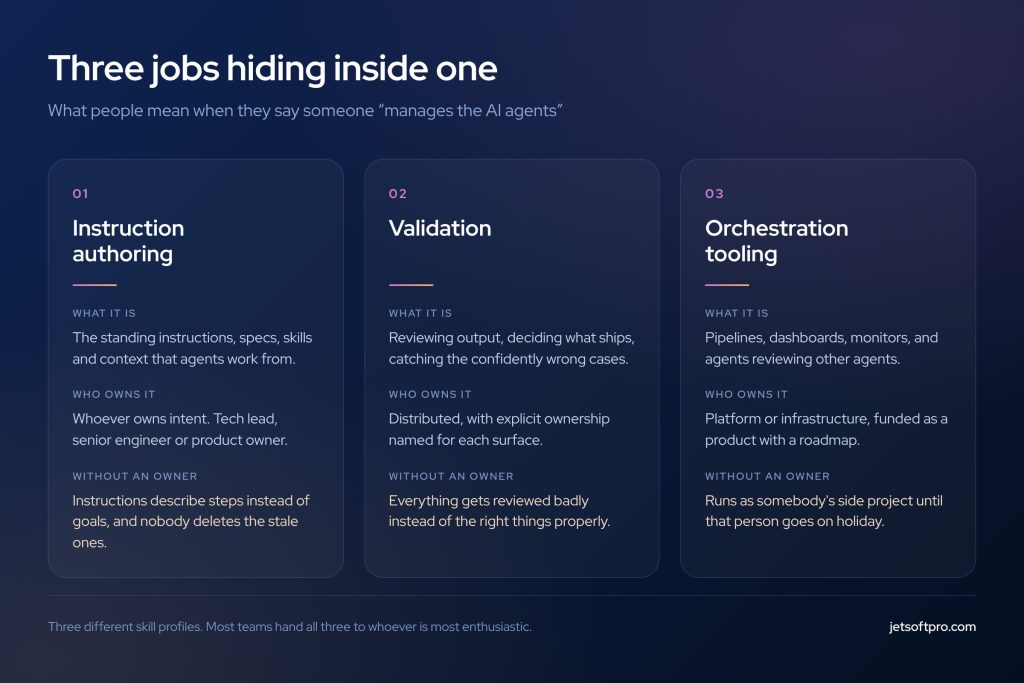
Teams usually treat this as a single responsibility, which is why it tends to land on whoever is most enthusiastic. It is actually three jobs, with three different skill profiles.
- Instruction authoring. Writing the standing instructions, specs, skills and context that agents work from. This is specification work, closest to writing good requirements. It has the highest leverage and the lowest visibility, because a well-written instruction looks like nothing happened.
- Validation. Reviewing output, deciding what ships, and catching the cases where the model is confidently wrong. This scales directly with volume and does not scale with headcount, so it is the first thing to break when agent output grows.
- Orchestration tooling. Pipelines, dashboards, monitors, and loops where one agent reviews another’s output. This is platform engineering, and it behaves like platform engineering: underfunded until it fails, then suddenly critical.
These three need different people. Although they are often handed to one person, that person usually has time for only one of them.
Who should manage AI agents on your team?
Not a new department, and not a new title bolted onto an existing team. The cleaner answer follows the three jobs above.
Instruction authoring belongs with whoever owns intent. Usually that is the tech lead, the senior engineer or the product owner, because writing what good looks like is the same muscle as writing a specification. Handing it to a junior engineer produces instructions that describe the steps rather than the goal.
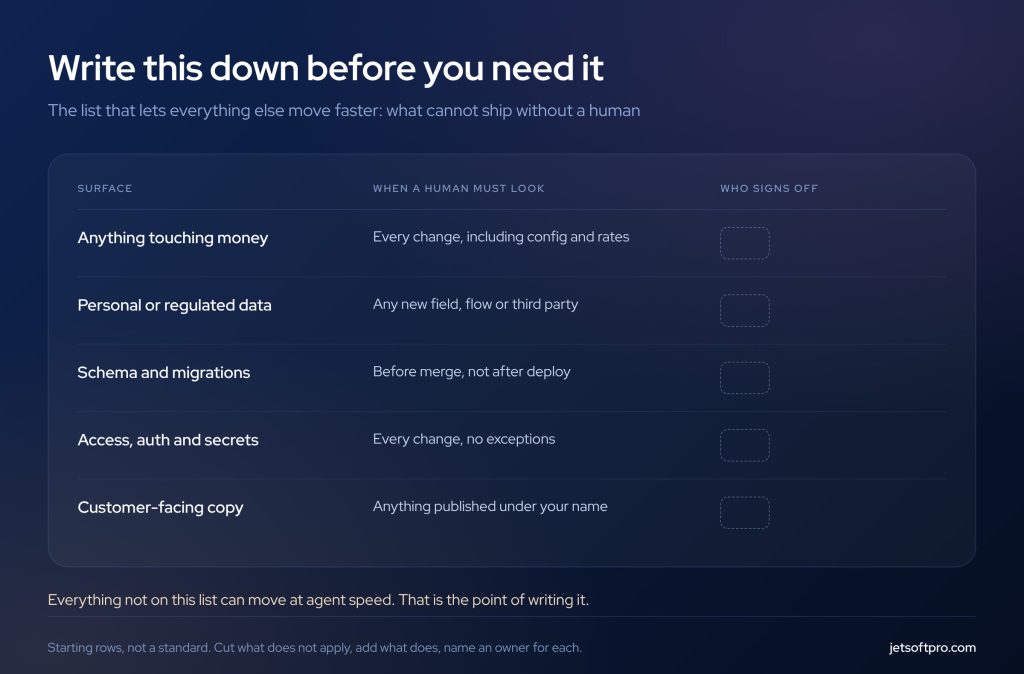
Validation should stay distributed, with explicit ownership per surface. The useful discipline here is negative: write down what cannot ship without a human looking at it. Teams that skip this step end up reviewing everything badly instead of reviewing the right things properly.
Orchestration tooling belongs with platform or infrastructure, funded as a product with a roadmap. Still, most organizations run it as somebody’s side project, which works until the person goes on holiday.
There is one more observation from the Anthropic data that is easy to miss. Individual contributors orchestrating teams of agents start to look like managers, in terms of the knowledge they need and the interdependencies they carry. If somebody on your team now coordinates a fleet of agents, they have taken on a management load. Give them the time that comes with it, or the load shows up as missed deadlines on their individual work.
Why context became infrastructure
Agents reason from what they can read. So anything decided in an unlogged meeting is, from their point of view, something that never happened.
The report has a small example that makes this concrete. An employee’s name sat on a months-old document about company swag. Long after their responsibilities changed, agents kept bringing them requests for t-shirts and mugs, because the document was the only context available. Stale context does not fail loudly. It just keeps producing confidently wrong work.
This is why the demand side of the Atlassian survey reads the way it does. 65% of developers want AI with persistent context across the codebase, team history and prior decisions, 54% want work that holds together across multiple steps, and 48% want specifications clear enough for an agent to execute reliably. Meanwhile, finding information remains the single largest source of friction at 51%, exactly as it was in 2025.
Documentation used to be hygiene, the thing you did after shipping if there was time. Now it is an input to the system. Teams that write decisions down in places agents can reach get better agent output, and the ones that keep decisions in meetings and direct messages do not.
Read: Who Writes the Code? A Practical Guide to Agentic AI in Software Development
What this changes in hiring
Anthropic reports that hiring managers there increasingly weigh autonomy and judgment over execution and narrow expertise, alongside a declining share of junior technical roles in headcount, hiring and job postings.
That is one company, and an unusually AI-saturated one, so treat it as a signal rather than a template for teams starting to manage AI agents now. Read it too literally, and you end up cutting the pipeline that produces the senior engineers you will need in three years.
What does transfer is the shift in what you are testing for. The ability to write a clear specification, to review unfamiliar code quickly, and to say precisely what good looks like matters more than it did. Those skills used to develop quietly over years of doing the work. Now they are the work, and they are needed earlier.
What to do before the work doubles again
Five practical steps to manage AI agents without losing the week to them, in rough order of how quickly they pay back.
- Name the work and budget the hours. If nobody has planned for four hours a week per developer, that time is being taken from something else, probably delivery.
- Assign owners to the three jobs. Instruction authoring, validation, orchestration tooling. One name each, written down.
- Treat standing instructions like code. Version them, review changes, and delete the ones nobody uses. Instructions that nobody owns become the stale swag document.
- Write down what cannot ship without a human. Specific surfaces, specific conditions. Everything else can move faster once that line exists.
- Measure output quality, not AI usage. Adoption dashboards reward activity and tell you nothing about whether the system improved. Review turnaround, change failure rate, and time from request to shipped change tell you something.
Agents do not reduce the amount of management a team needs. They move it from people to systems, and somebody still has to do it.
At JetSoftPro, we have spent twenty years building software, and we now run an AI-Centric approach across our own delivery lifecycle, not only in what we build for clients. The honest lesson from that is simple. The teams that get durable gains are the ones that treated the need to manage AI agents as a planned role with an owner and a budget, rather than as something clever people would figure out in the gaps between tasks.
JetSoftPro is an AI-Centric software engineering partner to companies across the US, UK and EU, with over 20 years of delivery experience. If AI agents are spreading through your workflows faster than anyone is managing them, let’s talk.