Here are two numbers about AI developer productivity, taken from the same annual survey, one year apart. In 2025, 68% of developers said AI saved them ten or more hours a week. In 2026, that figure is 26%.
Over the same period, adoption went up, not down. 95% of developers and 96% of engineering leaders say their organization actively uses AI in engineering, according to Atlassian’s State of Developer Experience 2026. Only 2% of developers say they do not use AI at all.
So the tools spread, the models improved, and the reported time savings fell by two-thirds.
That looks like a contradiction. It is not. It is the clearest signal yet about where AI developer productivity actually comes from, and why most organizations are not getting it.
What the AI developer productivity numbers actually say
Start with what did not change. Developers still report real benefit. 87% say AI helps them ship work faster. 80% say it helps them deliver more without working longer hours.
Those numbers are not in conflict with the collapse in hours saved. They measure different things. One measures how a task feels. The other measures what the week adds up to.
Three things happened between the two surveys.
- First, AI stopped being novel. When a tool is new, every hour it saves is visible. A year later, the same hour is just how the job works, and nobody counts it. Some of the drop is recalibration rather than loss.
- Second, the gains stayed local. 94% of developers use AI for individual tasks like coding, debugging, and implementation. That is where the speed landed. It did not travel across the handoffs between people, teams, and stages of delivery.
- Third, and this is the part that matters, new work appeared. 49% of developers now spend four or more hours a week managing AI tools. Among leaders, it is 57%. 65% say they spend time correcting AI-generated work that missed the original intent, rising to 72% for leaders.
Four hours a week is half a day. It came out of the same budget the savings were supposed to fill.
Read: 8 Signs That AI Integration in Software Development Is Actually Working
The AI developer productivity bottleneck moved, and most teams did not notice
The sharpest evidence for where it moved comes from the most AI-saturated company on record.
Anthropic published internal employment data in October 2026. By August, AI agent hours outnumbered employee hours six to one across the company, and nineteen to one in research organizations. Output per person rose accordingly. Code commits per engineer ran at 5.1 times their velocity six months earlier.
Then comes the number worth sitting with. Interactive Claude sessions spend roughly 80% of their wall-clock time idle, waiting for human input. One engineer in the report put it plainly. People are bottlenecking the agents.
The report also calculates what it would take to read everything the agents produce. For engineering and research functions, reading all interactive agent output would consume 424 hours per person per week. Even finance, legal, and sales functions land between 26 and 43 hours, which is most or all of a working week.
That is the shape of the problem. The constraint used to be writing the code. Now it is human attention, context, and judgment. Adding more generation capacity to a system constrained by review capacity does not produce more throughput. It produces a queue.
Atlassian’s data shows the same phenomenon from the other end, in organizations nowhere near Anthropic’s level of saturation. The direction is identical. Only the intensity differs.
Read: AI-First Teams: How Roles, Skills, and Expectations Are Shifting in 2026
The friction that was always there is still there
If AI had removed the real obstacles, the time savings would have compounded. It did not, because the obstacles were never mostly about typing speed.
Only 28% of developers say they have noticeably less friction than before AI. 50% say they have about the same amount, in a different shape.
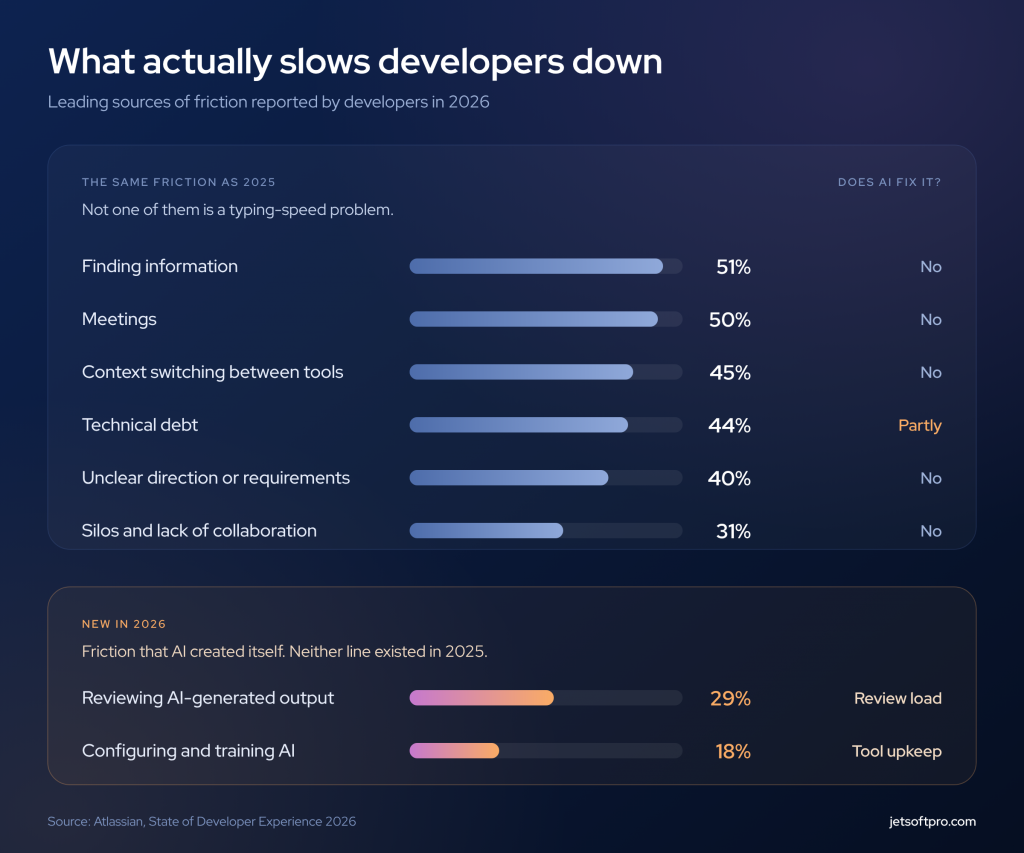
Finding information has topped this list two years running. It is also the thing AI was supposed to fix.
Then there is the new category. 29% of developers name reviewing or managing AI-generated output as a source of friction. 18% lose time configuring and training AI to work reliably inside their workflows.
These friction points feed each other. When context is hard to find, teams default to meetings to force alignment. When code generation gets fast, and context stays fragmented, there is more output to align on, so there are more meetings. Speed in one part of the system raises pressure everywhere else.
Faster code, lower confidence
There is a second tension in the data that most coverage skips. 59% of developers say AI-assisted output is higher quality than what they produce without it. At the same time, 73% say AI-driven speed can come at a cost to quality.
Both are true, because they describe different layers. AI genuinely improves a single task by catching errors and offering alternatives. It also generates output that can lack context, introduce subtle problems, or miss the actual intent, which pushes cost into review and testing.
Atlassian DX measured this across more than 500 companies between the first and second quarters of 2026. Code maintainability rose 3.8%. Change confidence fell 6.1%.
Read those together, and you get something uncomfortable. Developers understand the code in front of them better than before. They trust what they are shipping less.
Worth noting that this is not automatically a code quality problem. Anthropic ran the comparison directly, checking code written by a person against code written by that same person’s agent, in the same month and the same directory. They found no difference in rates of lines later removed or reverted. The output held up.
Which points at the real variable. The question is not whether AI writes acceptable code. It is whether the engineering system around it has the context, review practice, and controls to handle the volume responsibly.
What the 17% do differently, and why strategy decides AI developer productivity
The most useful finding in the Atlassian data is also the most overlooked.
Only 17% of developers say their organization has a clear, actively implemented AI strategy across the software delivery lifecycle. Among leaders, 23% say the same.
So roughly four out of five engineering organizations have near-universal AI adoption and no legible operating model for it. That gap is the whole AI developer productivity story.
Split the responses by strategy and the outcomes separate sharply:
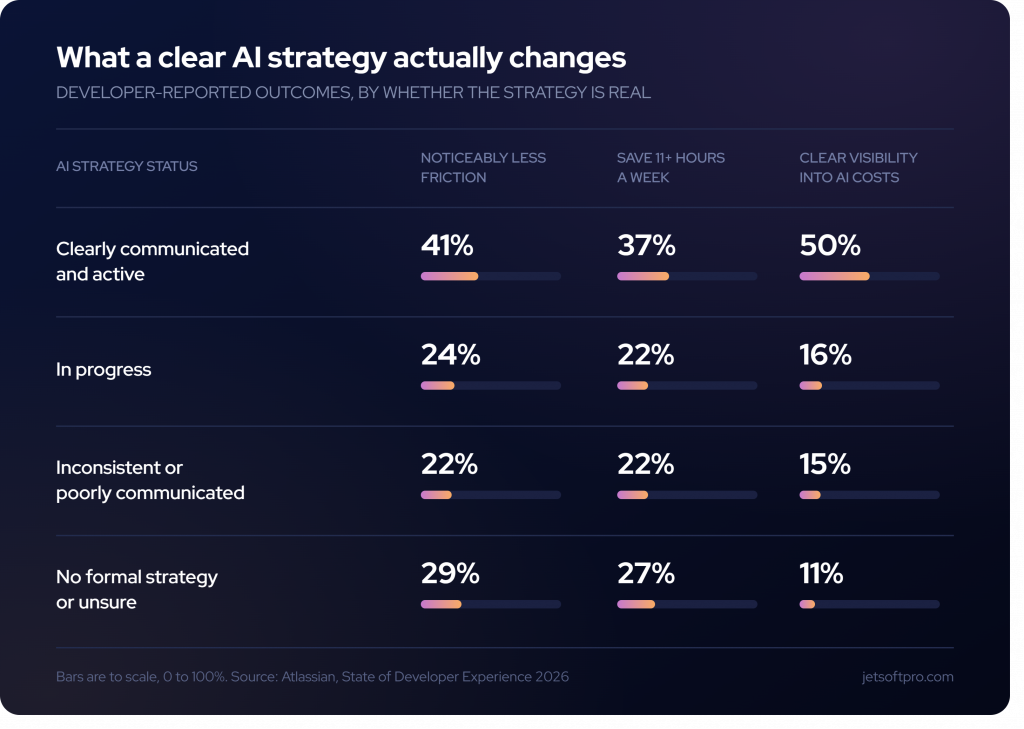
Developers in organizations with a clear, active strategy are nearly twice as likely to report less friction as those where the strategy exists but is communicated badly. They are also more than four times as likely to say their organization can see and manage what AI actually costs.
Notice the row that breaks the pattern. Organizations with no strategy at all score better on friction than organizations with a bad one. A half-implemented strategy is worse than none, because it adds process without adding clarity.
The developers themselves are specific about what a real strategy would include. 65% want AI with persistent context across the codebase, team history, and prior decisions. 54% want AI that can complete multi-step work end to end. 48% want help making plans and specifications clear enough for agents to execute reliably.
None of those three is a request for a better model. All three are requests for a better system around the model. Context that persists. Work that holds together across steps. Intent that survives the handoff to something that cannot ask a clarifying question in the hallway.
The measurement trap that makes everything worse
Then there is how organizations check whether any of this is working.
60% of developers say AI use is treated as a productivity signal where they work. 41% admit they sometimes use AI more than necessary because they feel expected to. 68% say greater AI use does not accurately reflect the value they deliver.
Leaders mostly know. 81% agree that measuring AI use can create the wrong incentives. 59% worry about performative AI use. Only 42% say they have the right metrics to tell genuine gains from inflated activity.
That is a system measuring the thing it can count rather than the thing it wants. Tool adoption, token spend, generated volume, and accepted suggestions are all easy to capture. They are also easy to game, and none of them answers whether the organization is delivering more value.
The questions that do answer it are harder to instrument:
- Are teams delivering valuable changes with more confidence
- Are developers waiting less for context and approvals
- Is quality improving without hidden rework
- Are engineers building the judgment needed to direct and validate AI safely
This also explains part of why self-reported AI developer productivity fell. If AI use is a performance signal, some of that use is theatre, and theatre does not save anyone time.
Where this leaves engineering leaders
Put the two reports side by side, and the conclusion about AI developer productivity is consistent.
AI reliably makes individual tasks faster. That gain does not become organizational capacity on its own. It converts only when the system around the work can absorb the extra output, which means context people and agents can both reach, review practices that scale with volume, clear intent at the point where work is assigned, and measurement that looks at outcomes rather than activity.
Where that system is missing, the speed arrives as pressure. More output to review, more coordination, more meetings, more time spent managing the tools themselves. That is the 26% figure. The hours did not vanish. They moved into work nobody planned for.
There is one more number worth keeping in view. For the third year running, a majority of developers say leadership does not fully understand the challenges they face: 44% in 2024, 63% in 2025, 66% in 2026. You cannot design an operating model for work you cannot see accurately.
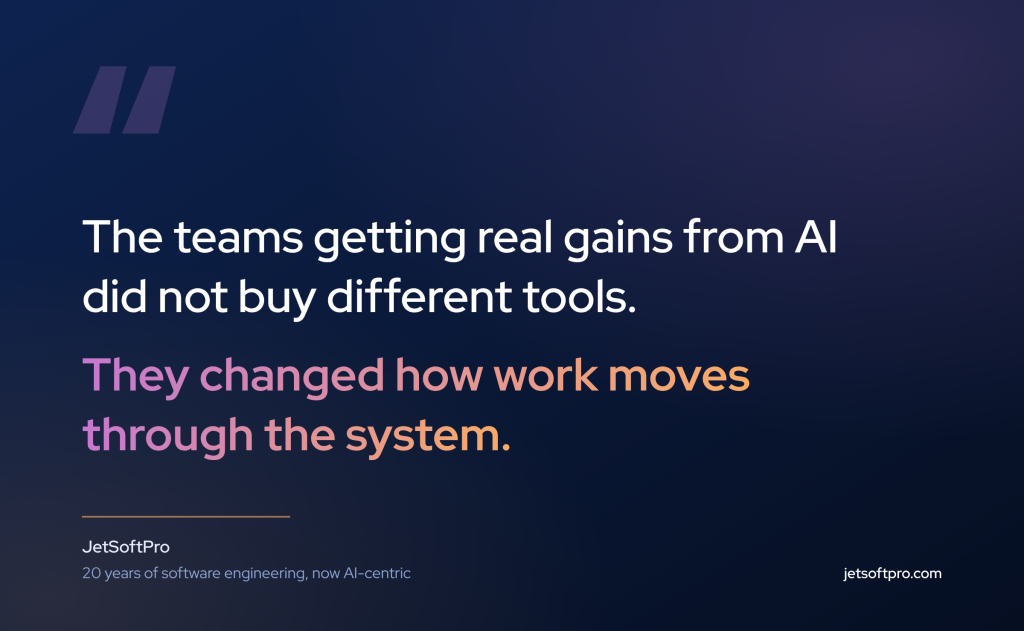
At JetSoftPro, we have spent twenty years building software, and the last few building it with AI in the critical path. The pattern we keep seeing matches this data closely. Tool rollouts produce local speed. Operating model changes produce delivery capacity. The second kind of work is slower, less visible, and it is where the compounding actually happens.
JetSoftPro builds AI-native software products and has been an engineering partner to companies across the US, UK, and EU for over 20 years. If your AI adoption is high and your delivery metrics have not moved, let’s talk.