Every conversation about agentic AI modernization eventually runs into the same two numbers. 85% of enterprises say legacy systems are blocking their AI adoption, and those same systems consume roughly 80% of the IT budget.
Read them together, and the conclusion writes itself. The old system is in the way, so replace it.
Look closer at what those numbers are measuring and a different picture appears. The 80% figure is maintenance spend, meaning the cost of keeping systems running rather than the cost of changing them. The 85% figure is a judgement call by the people responsible for AI delivery, and in almost every case it means one specific thing: that something cannot reach the data or the logic it needs. Those two facts point in opposite directions. The first says you have very little budget for a rebuild. The second says you may not need one, because a blocked integration is a narrower problem than an obsolete system.
That distinction is where a lot of agentic AI modernization programmes quietly die. A full rebuild is a multi-year commitment with unclear milestones, business teams waiting a long time for anything usable, and engineering spending months reconstructing logic that already worked. The pattern is well documented, and big-bang rewrites tend to become programmes rather than projects. Meanwhile, the capability you wanted is still eighteen months out.
The more useful path starts somewhere less dramatic, with finding out what your existing architecture can actually support today.
The question worth asking before any agentic AI modernization work
Most teams start by asking how to add an agent. The more useful question is what has to change in the system they already have, so an agent can work with it without breaking things.
That reframe changes the shape of the work. Adding an agent is a project. Making an architecture agent-ready is a sequence of smaller, independently valuable changes, most of which you would want to make anyway. Cleaner data access, documented APIs, business logic that lives somewhere retrievable, identity that handles non-human callers. None of that is wasted effort if your agent strategy changes next year.
It also explains why so many pilots succeed and so few reach production. A pilot works around the architecture. Production has to work with it.
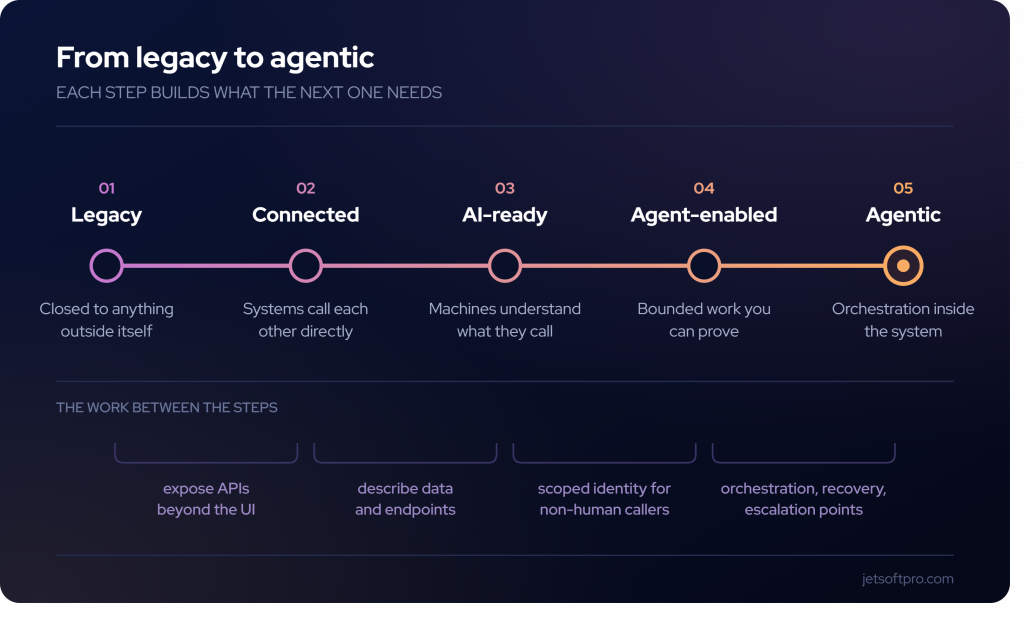
The five stages of agentic AI modernization, and why skipping one does not work
Agentic AI modernization moves through five recognisable states. The labels matter less than the transitions, since each one unlocks something the next stage depends on.
1. Legacy.
Business logic and data are reachable only through the application that owns them. Integration happens through file exports, scheduled jobs, or a person copying values between screens. The system works, often reliably, and it has no surface anything else can call.
2. Connected.
The system exposes APIs, and other systems use them. Data can leave without a human in the loop. This is the stage most enterprises reached years ago for their core platforms and never finished for everything else, which is why the estate is usually mixed.
3. AI-ready.
Connected is about machines talking to each other. AI-ready is about machines that need to understand what they are talking about. Data is described, not only accessible. APIs are documented in a way that explains what an endpoint is for, rather than only what it accepts. Business rules exist somewhere readable. The distinction sounds academic until an agent picks the wrong endpoint because two of them have similar names and no descriptions.
4. Agent-enabled.
Capabilities are exposed deliberately as tools, with scoped permissions, an identity model that handles a non-human caller, and logging that captures what was called and on whose behalf. At this stage, an agent can do real work in a bounded area, and you can prove what it did.
5. Agentic.
Orchestration moves into the system. Agents coordinate across multiple capabilities, handle multi-step work, recover from failures, and escalate to a human at defined points. This is the stage everyone is aiming at, and it only holds if the four below it are solid.
The reason you cannot skip stages is not difficulty; it is dependency. As one 2026 analysis puts it plainly, AI agents cannot deliver business value if they cannot securely access the systems where the business actually happens. An agent pointed at a Legacy system has nothing to hold on to. An agent pointed at a Connected system can call things and has no idea which one to call. Each stage exists because the one above it needs it.
Worth saying clearly: most enterprises are not at a single stage. Payments might be Connected, the data warehouse AI-ready, and a twenty-year-old scheduling system still firmly Legacy. Agentic AI modernization is domain by domain, not a single company-wide level.
Read: Agentic AI Architecture: How Enterprise Software Is Being Redesigned
Agentic AI modernization starts with an audit, not a plan
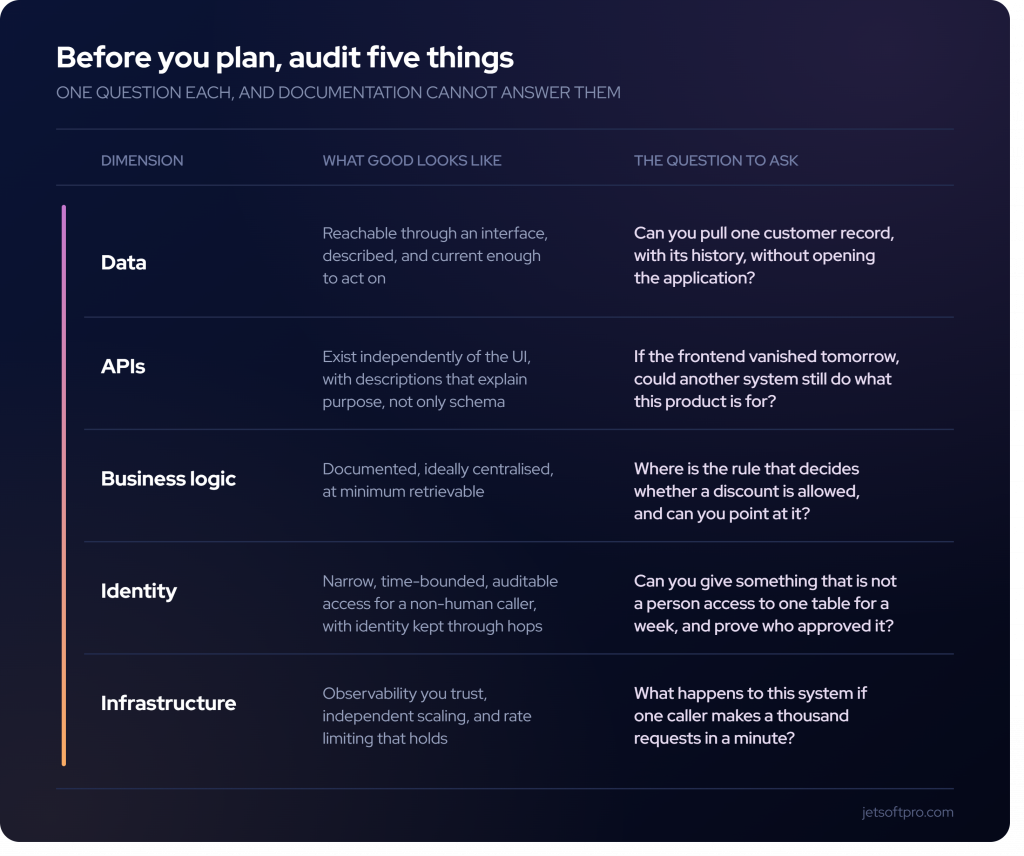
An honest assessment takes a few weeks and saves quarters. Five dimensions decide what is possible, and each one has a question that cuts through the documentation quickly.
Data
This is the most common blocker, and research on AI readiness names it directly as trapped data, where enterprise context sits inside rigid architectures that make contextual access nearly impossible. An agent needs to retrieve a record without knowing in advance which screen it belongs to.
What good looks like: data reachable through an interface rather than a report, described well enough that something can select from it, and current enough that acting on it is safe.
The question to ask: can you get a single customer record, with its related history, without opening the application?
If the honest answer involves a nightly export, that is your first piece of work.
APIs and integrations
Many systems have APIs that exist only to serve their own frontend. They work, they are undocumented, and the parameter names made sense to one developer in 2014.
What good looks like: APIs that exist independently of the UI, with descriptions that explain purpose and not only schema. This matters more than it used to. A developer reads documentation once and absorbs the confusion. An agent reads it on every call, so vague descriptions turn into wrong tool selection in production.
The question to ask: if the frontend disappeared tomorrow, could another system still do the three things this product is for?
Business logic
Here is where legacy estates hurt most. Brittle codebases relying on tribal knowledge, with undocumented business rules built fifteen to thirty years ago, are a recognised category of AI readiness failure. When the rules live in stored procedures, in conditional logic scattered across a monolith, and in the memory of two people who have been there longest, an agent has no way to respect them.
What good looks like: rules that are documented, ideally centralised, and at minimum retrievable.
The question to ask: where is the rule that decides whether a discount is allowed, and can you point at it?
This is also where AI helps with its own prerequisites. Morgan Stanley built an internal tool that turns legacy code into plain-English specifications and reports, saving more than 280,000 developer hours. The number is impressive, and the direction of the work is the more interesting part. They did not use AI to rewrite the system; they used it to recover the specification the system was built from, which is the artefact nobody kept. Recovering documentation from code is now a supervised agent workstream rather than a year of archaeology, and it produces something an agent can later read at runtime. One piece of work, two payoffs.
Identity and permissions
The dimension teams underestimate most consistently. Traditional access control knows two things, users who authenticate and carry roles, and service accounts with fixed rights. An agent sits awkwardly between them, sometimes acting for a specific person and needing exactly that person’s permissions, sometimes running on a schedule with its own scoped rights.
What good looks like: the ability to issue narrow, time-bounded, auditable access to a non-human caller, with the acting identity preserved through every hop.
The question to ask: can you give something that is not a person read access to one table for one week, and later prove who authorised it?
If that requires a broad service account, you have found the work that has to happen before anything agentic goes near production.
Infrastructure
Agent traffic does not look like human traffic. It arrives in bursts, it retries, it reads far more than it writes, and it does not observe business hours. Aging architectures were not designed for dynamically scaling agentic workloads, and load patterns are usually where that shows up first.
What good looks like: observability you can trust, the ability to scale a component independently, and rate limiting that protects the system from a caller in a retry loop.
The question to ask: what happens to this system if one caller makes a thousand requests in a minute?
Agentic AI modernization means deciding what to expose, and what to leave alone
Most modernization writing stops at making things accessible. The harder judgement is what should stay closed.
Not every capability belongs in an agent’s reach, and the filter has three parts.
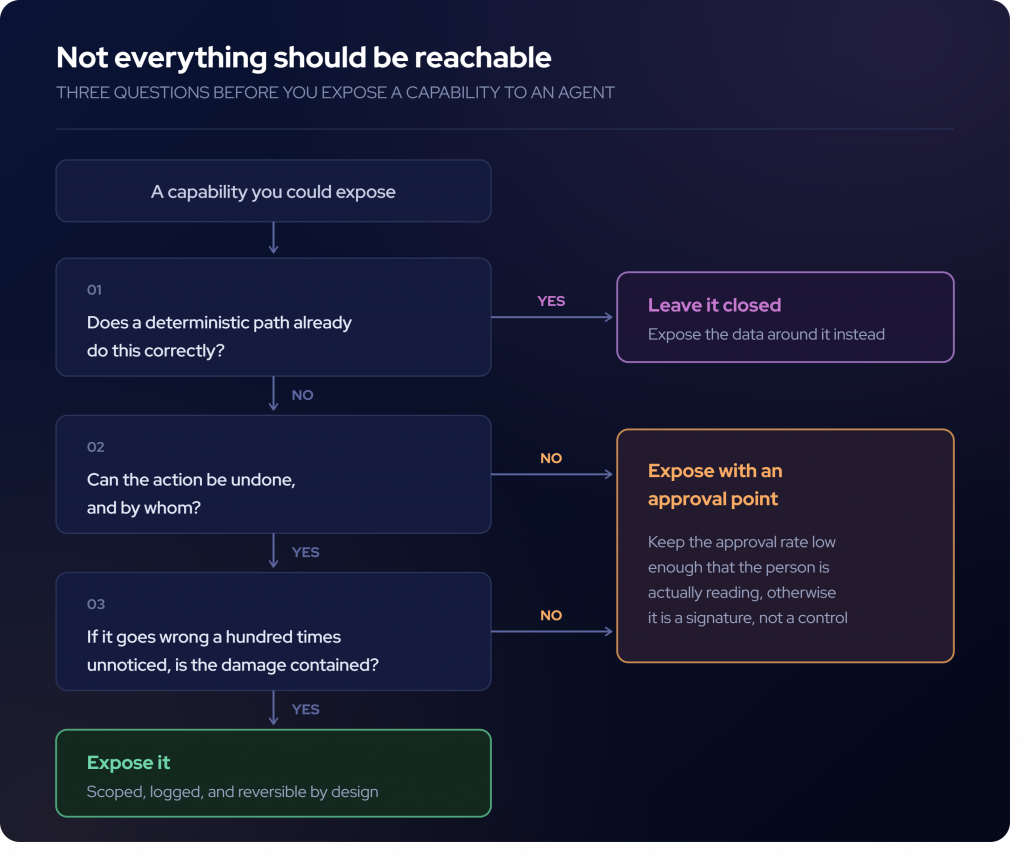
Reversibility. Can the action be undone, and by whom? Reading a record is reversible by definition. Sending a customer email is not. Posting a journal entry is technically reversible and practically visible to an auditor. Irreversible actions can still be exposed, and they need an approval point attached rather than open access.
Blast radius. If this call goes wrong a hundred times before anyone notices, what is the damage? A wrong summary is noise. A wrong price update propagates into orders, invoices, and customer trust. Blast radius decides how much guardrail a capability needs, and sometimes decides that the answer is no.
Whether a deterministic path already works. If a process needs to produce identical output from identical input, a reasoning layer inside it adds variance to something whose whole value is the absence of variance. Payroll runs, billing cycles, and regulatory reports fall here. Expose the data around them so agents can investigate exceptions and prepare inputs. Leave the calculation in code.
A practical example of getting this wrong. A team exposes an inventory adjustment tool because it is genuinely useful for handling stock discrepancies, then discovers that the agent adjusts inventory to resolve a mismatch that was actually a data sync delay. The tool worked exactly as described. It should have been read-only with a human writing the adjustment.
Only then, add the agentic workflows
With the audit done and the exposure decisions made, the first agentic workflow is a much smaller step than it looked at the start.
Go one domain at a time. The pattern that works in 2026 is strangler-fig waves, where new capability grows alongside the existing system rather than replacing it in one cutover. The legacy system keeps running. The agent handles a bounded slice. Scope expands as confidence does.
Choose the first use case on tolerance for variance rather than on value. The instinct is to pick the most expensive manual process, which is usually something like reconciliation or invoice processing. Those are excellent automation targets and mostly for deterministic automation. A better first choice is work that is genuinely ambiguous, where a human currently applies judgement, and where a slightly different approach on Tuesday is acceptable. Research tasks, triage, drafting, investigation of exceptions.
Put the human checkpoint where the irreversible actions are, and keep the rate low enough that the person is actually reading. An approval step that fires forty times an hour stops being a control and starts being a signature.
What agentic AI modernization actually takes
Specific numbers depend entirely on the estate, and anyone quoting a figure without seeing your systems is guessing. A few things about the shape of the effort are consistent enough to plan around.
It is measured in months rather than weeks. Typical enterprise migration work in 2026 runs somewhere between six and eighteen months depending on data volume, schema complexity, and how much AI readiness is in scope. The audit itself is fast. Fixing what the audit finds is the part that takes time.
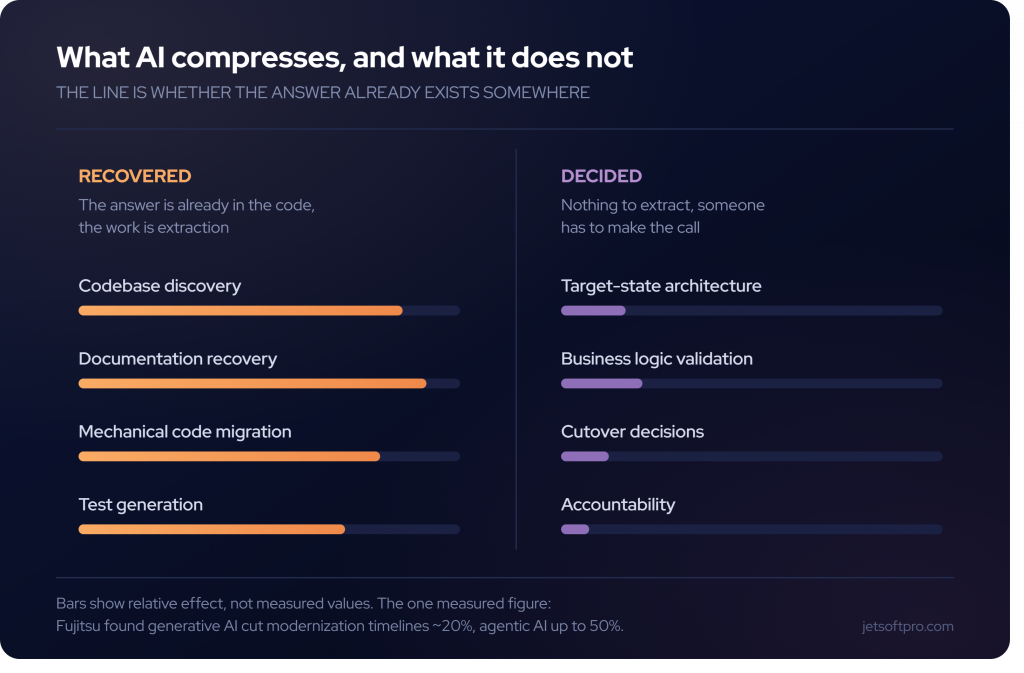
AI has genuinely changed the economics of the unglamorous parts, though the size of the effect depends on which part you are looking at. Fujitsu’s trials found generative AI cut modernization timelines by around 20%, and agentic AI by up to 50%. That gap between 20 and 50 is the most instructive number in this whole area, because it is not a measure of model quality. Generative AI helps a developer write faster, which compresses one task at a time. Agentic AI runs a workstream, which compresses the sequencing and the waiting between tasks. The lesson is that the savings come from restructuring how the work flows rather than from putting a better assistant next to the same process.
Read more: Who Writes the Code? A Practical Guide to Agentic AI in Software Development
Where that compression lands is also uneven, and worth knowing before you build a plan around it. Codebase discovery, documentation recovery, and mechanical code migration, the three most expensive line items in most programmes, convert from months of senior engineer time into supervised agent workstreams. All three share a property. The correct answer already exists somewhere, inside the code, and the work is extraction rather than invention. Anything where the answer has to be decided rather than recovered compresses very little, which is why target-state architecture, business logic validation, and cutover decisions still take the time they always took.
This is mainstream rather than experimental now. Microsoft ships a modernization agent inside GitHub Copilot that produces assessment reports, issues, and pull requests per application, and more than 75% of enterprises use AI somewhere in their modernization strategy. Read that 75% carefully though, because using AI somewhere in a strategy is a very low bar, and it sits alongside the earlier finding that 85% still consider legacy a blocker. Both can be true at once, and the reason they are is that most of this adoption is pointed at writing code faster rather than at making systems reachable. Faster code in an architecture an agent cannot call does not move the blocker.
The staffing shape changes in a way worth planning for. Modernization with agents needs fewer people but more senior ones, engineers who can review at volume, architects who can define target states precisely, and domain experts with real decision authority. This follows directly from the point above. If agents absorb the extraction work and humans keep the decisions, the remaining human work is almost entirely judgement, and judgement does not distribute across junior capacity. The work that does not compress is architectural judgement, business logic validation, organisational change, and accountability. On that last point, the same analysis is blunt, and correctly so. “The agent did it” is not a control environment.
Sequencing matters more than total duration for how this feels to the business. An audit produces decisions in weeks. Each dimension you fix has standalone value. The first bounded workflow can ship long before the estate is finished. A programme structured that way survives a budget review, and a two-year rebuild with nothing shippable until month twenty usually does not.
Where agentic AI modernization goes wrong
Four patterns, all avoidable.
- Starting with the rebuild. The system is old, the team wants a clean foundation, and the rebuild becomes the project. Two years later there is a better architecture and no agentic capability, because the capability was always downstream of the rebuild finishing.
- Exposing everything at once. Making the whole API surface available to an agent feels efficient and removes the exposure decisions described above. It also means the first incident involves a capability nobody consciously decided to grant.
- Treating identity as a later problem. This one is specific and expensive. Permissions get deferred to unblock a demo, the agent gets a broad service account, and the question of who authorised a given action has no answer. Retrofitting proper delegated identity onto a running system costs considerably more than building it in at the start.
- Picking a deterministic process as the first use case. Covered above, and worth repeating because it is the most common selection error. It produces correct results in testing, a different interpretation of an edge case in month three, and a finance team that no longer trusts the programme.
How we frame agentic AI modernization
Everything above is a variation on one idea. The agent is the last thing you build, not the first thing you decide.
At JetSoftPro, we see agentic AI as an architecture challenge as much as an AI challenge.
The teams that get to production start by understanding what their existing systems can support, fix the specific things that block a non-human caller from working reliably, decide deliberately what to expose, and then add orchestration on top of a foundation that can hold it. None of those steps require a rewrite. All of them are worth doing regardless of which model you end up using.
JetSoftPro builds AI-native software products and has been an engineering partner to companies across the US, UK and EU for over 20 years. If you want an honest read on where your existing architecture sits on this path, let’s talk.