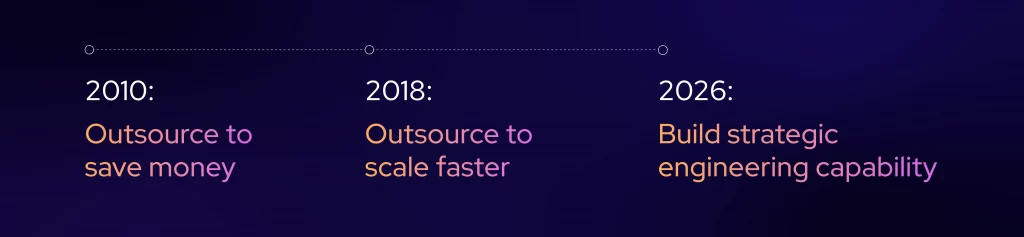
There used to be a simple equation at the heart of software outsourcing: find the lowest hourly rate, staff up, ship code. For a long time, it worked. Choosing the right software development partner mattered less than finding the cheapest one because arbitrage in developer salaries across markets could shave 40–60% off engineering budgets. When the task was straightforward enough, the quality delta felt acceptable.
That era is not coming back. And the companies still selecting a software development partner purely on day rate are quietly accumulating a competitive disadvantage they won’t notice until it’s too late.
This isn’t an argument against working with external engineering teams — far from it. It’s an argument for doing it differently and understanding why the old model is breaking down faster than most leaders realize.
Why the cost-arbitrage model is running out of road
The numbers tell part of the story. In 2020, 70% of organizations cited cost reduction as their primary driver for outsourcing. By 2024, that number had fallen to just 34%, according to Deloitte’s Global Outsourcing Survey. That’s not a rounding error — it reflects a genuine shift in what companies are trying to accomplish when they bring in a software development partner.
Meanwhile, the rate landscape is still stratified by geography — in 2026, Eastern European development rates average $25–$45/hour versus $120–$200/hour in North America — but that gap is narrowing in meaningful ways. As AI tooling raises baseline productivity everywhere, and as demand for AI-fluent engineers outpaces supply across all markets, the arbitrage on raw headcount is compressing.
Software Development Partner vs. Vendor: Your Strategic Decision in 2026
More fundamentally, the work itself has changed. The tasks that used to justify commodity outsourcing — boilerplate development, manual testing, repetitive integrations — are precisely the tasks AI handles best. What remains valuable is harder to buy cheaply: architectural judgment, deep product context, AI system design, evaluation frameworks, the ability to make good decisions under ambiguity. A software development partner who can provide these capabilities is worth fundamentally more than one offering only execution capacity.
Three out of four companies now want their outsourcing partners to drive transformational outcomes — new business models, technology innovation — not just cost savings. (Source: KPMG, The Future of Outsourcing: Rethink Everything, 2025)
The hidden costs of treating a software development partner like a commodity
The surface appeal of commodity outsourcing is real: lower day rates, flexible contracts, no hiring overhead. What rarely gets calculated are the costs on the other side of the ledger.
1. Context loss is expensive
Every time a vendor team turns over — and they do, frequently, because commodity vendors compete on price, and price pressure means thin margins and high churn — the software development partner loses the accumulated understanding of your system, your technical decisions, your product constraints. A new developer starting fresh on your codebase doesn’t just need time to ramp; they need time to understand why things are built the way they are, which decisions were intentional and which were technical debt, where the landmines are. That knowledge gap has a real cost in rework, in slower delivery, in decisions that look locally correct but break things elsewhere.
2. The coordination overhead scales badly
Running a transactional vendor relationship requires more internal management time than most companies budget for: detailed specs, constant review cycles, handoff friction, QA overhead to catch what slips through. In practice, many companies end up hiring expensive internal engineers specifically to manage cheap external ones — partially defeating the economics.
3. The AI integration gap is widening.
This is the newest and sharpest version of the problem. AI-augmented teams demonstrate 30% faster cycle times with significantly fewer coordination cycles, according to Codebridge’s 2026 outsourcing analysis. A commodity body-shop — however experienced at traditional development — typically lacks the AI workflow integration and product depth to deliver that kind of output. You get the old speed at the old (or higher) price.
25% of outsourcing relationships fail within two years, and 66% of IT projects exceed budget. These aren’t caused by incompetent vendors. Deloitte’s research shows the most common outsourcing challenges are internal management issues, not vendor performance problems — the model itself creates the conditions for failure.
What a strategic software development partner actually looks like
The phrase gets used loosely, so it’s worth being precise about what distinguishes a strategic software development partner from a better-than-average vendor relationship.
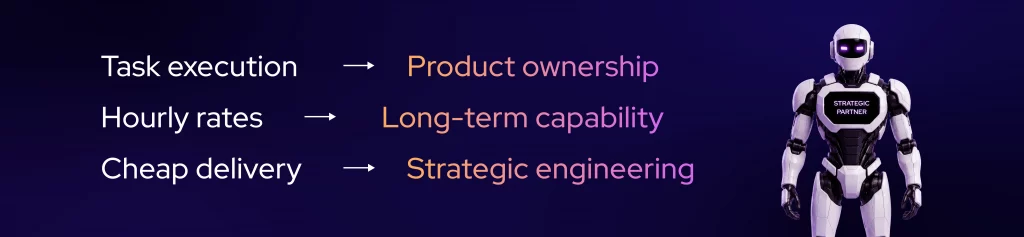
A vendor delivers what you specify. A partner helps you figure out what to specify — and tells you when what you’ve specified is wrong.
That distinction has concrete implications:
- Embedded product context. A strategic software development partner understands your business model, your users, your architecture history, and your competitive pressures. They don’t just execute tickets — they ask whether the ticket solves the right problem. This requires continuity, which requires a relationship structured around long-term value rather than the lowest transaction cost.
- Genuine technical leadership, not just execution. The most valuable thing a software development partner can do is catch bad decisions before they become expensive. That requires senior engineers with enough standing in the relationship to say “this approach has a problem” and be heard — not junior developers executing specs with no visibility into the bigger picture.
- AI-native delivery. In 2026, a strategic software development partner should be running AI-augmented workflows as default, not as an upsell. Gartner predicts 80% of organizations will evolve large software engineering teams into smaller, AI-augmented teams by 2030. The right partner is already there — and can bring that capability into your product rather than you having to build it from scratch internally.
- Knowledge transfer as a deliverable. One of the most reliable signals of a commodity engagement is that the partner optimizes for continued dependency. A strategic software development partner optimizes for your capability — they document, they train, they structure the engagement so your internal team gets smarter over time, not more dependent.
The market is reorganizing around this logic
- Vendor consolidation is accelerating. Enterprises are moving from managing 8–12 vendor relationships to 2–3 deeper ones. The driver is straightforward: coordinating many shallow partnerships has high overhead and produces fragmented institutional knowledge. Fewer, deeper relationships with the right software development partner are more efficient to manage and more likely to produce teams that actually understand your systems.</mark>
- Contract structures are shifting in parallel. Mid-term contracts — typically 18–36 months — are becoming the dominant model, according to Coherent Market Insights’ 2026 IT outsourcing analysis. Enterprises avoid short-term engagements that lack depth and long-term ones that lock in approaches before the technology landscape settles. Mid-term agreements balance adaptability with strategic alignment.
- Cybersecurity is the clearest signal of how the perception of a software development partner has changed. As recently as 2023, security ranked among the least-outsourced IT functions — companies were reluctant to hand critical systems to an external party. By 2025, cybersecurity ties with infrastructure services as the most outsourced business function across enterprises, according to Deloitte’s latest Global Outsourcing Survey. You don’t outsource something that critical to a commodity vendor. You outsource it to a software development partner you trust with consequential decisions.
Read: AI-First Teams: How Roles, Skills, and Expectations Are Shifting in 2026
What to look for when choosing a software development partner
Given that the market is moving in this direction, the practical question is how to evaluate candidates. Here are the signals that separate genuine partners from vendors with better marketing:
- Senior-heavy team composition. The most effective outsourced teams maintain 50–60% senior ratios, with measurable impacts on architectural quality and delivery speed. If a prospective software development partner leads with headcount flexibility and cost-per-seat, they’re optimized for something different than partnership.
- AI workflow integration that’s real, not aspirational. Ask for concrete examples of how AI tooling is embedded in their delivery — not just “we use Copilot,” but how they evaluate AI-generated code, manage prompt engineering across teams, and measure productivity gains. AI-augmented delivery is a capability, not a checkbox.
- Demonstrated context retention over time. Ask how they handle team continuity, how they document institutional knowledge, and what their churn rates look like. The economics of commodity outsourcing create structural incentives to rotate people; a software development partner who has solved this problem has done so deliberately.
- Willingness to push back. This one is harder to assess in a sales process but worth probing directly. Ask for an example of a time they told a client their technical approach was wrong. If the answer is smooth and generic, that tells you something.
- Outcome alignment, not just output delivery. The best software development partnerships are structured around business outcomes — delivery speed, system reliability, capability transfer — not hours logged or tickets closed. If a partner can’t speak to how they’d measure success in terms of your business results, they’re still thinking like a vendor.
The JetSoftPro perspective: what 20 years tells you
Over 20 years as a software development partner to product companies and enterprises, we’ve watched the outsourcing market go through multiple cycles. The current moment feels genuinely different from previous shifts.
What’s changed is the underlying economics. When AI handles a growing share of execution-layer work, the remaining human contribution becomes predominantly judgment, context, and architectural thinking. These are not scalable through headcount. They’re built through relationships, institutional knowledge, and trust accumulated over time.
The clients getting the most value from their software development partner today share a few characteristics: they invest in onboarding their partner into product context the same way they’d onboard a senior internal hire; they structure engagements around outcomes rather than FTE counts; and they treat technical recommendations as input to their own decision-making, not just execution of their specifications.
The clients running into problems are largely those who bought the “strategic partnership” positioning without changing the underlying relationship model — same thin specs, same high churn tolerance, same measurement by hours delivered.
The most productive client relationships we’ve built share one quality: the client treats us as an extension of their technical leadership, not a contractor executing specs. That changes what we can contribute — and it changes the outcomes.
Moving from vendor to software development partner: the practical transition
For organizations looking to shift their approach, the transition doesn’t require scrapping existing relationships. It requires changing how they’re structured and measured.
- Start with context transfer, not just contract renegotiation. The most immediate leverage point is investing in your software development partner’s understanding of your business and product — architecture decision records, documented technical rationale, access to product roadmap discussions. This compounds over time.
- Restructure measurement. If you’re measuring your engineering partner by velocity metrics or hours billed, you’re measuring the wrong things. Shift toward delivery quality, architectural decision outcomes, and capability building within your internal team.
- Reduce the number of partners, deepen the remaining ones. The productivity gains from a deeply embedded software development partner outweigh the flexibility benefits of maintaining multiple shallow relationships, particularly for core product engineering. Reserve staff augmentation for genuinely short-term, well-scoped needs.
- Evaluate AI-native delivery explicitly. As agentic AI capabilities move from pilot to production through 2027, the gap between AI-augmented and traditional delivery will widen. A partner who is ahead of that curve now will be substantially more valuable in 18 months than one who is still catching up.
Read: Developer as a Service (DaaS): Will There Be a Subscription for Developers?
Worldwide IT spending is projected to reach $6.15 trillion in 2026, with software spending alone exceeding $1.4 trillion. The demand for external engineering capacity is growing. What’s contracting is the viability of treating that capacity as a commodity.
The companies that figure this out early won’t just get better software. They’ll build a structural advantage that’s genuinely difficult for competitors to replicate because the institutional knowledge embedded in a real software development partner relationship can’t be bought off a rate card.