The way AI-first teams are structured looks fundamentally different from what most software organizations have built over the past decade. You had your PMs, architects, developers, QA engineers, DevOps specialists, and a scrum master holding the whole thing together. That model was stable because the underlying economics were stable: more features required more people, more complexity required more coordination layers.
That world is ending.
Not because AI is replacing engineers, the reality is more nuanced and more interesting than that. It’s because AI is eliminating the economic logic that held the old structure together. When an AI assistant can generate boilerplate, scaffold tests, draft documentation, and propose architecture alternatives in seconds, teams no longer need as many people doing those things. They need different people doing different things.
At JetSoftPro, we’re seeing this shift firsthand across our projects and client engagements. This blog is about what’s changing, where it’s heading, and what teams should actually do to prepare.
The Numbers Behind the Shift
Before getting into structure and skills, it’s worth understanding the scale of what’s happening.
According to McKinsey, AI adoption at work jumped from 30% of employees in 2023 to 76% by 2025. The World Economic Forum projects that 65% of developers expect their role to be redefined in 2026 alone, moving away from routine coding toward architecture, integration, and AI-enabled decision-making.
Meanwhile, PwC’s 2025 Global AI Jobs Barometer found that workers with advanced AI skills earn up to 56% more than peers in identical roles without those skills. The wage premium is already baked in. The market has made its judgment.
And skills themselves are expiring faster: the WEF estimates 39% of current skill sets will be outdated or transformed between 2025 and 2030. That’s not some distant reckoning, it’s happening across five-year windows that overlap with where most teams are right now.
Read: AI in 2026 by the Numbers: What C-Level Leaders Need to Do Next
What AI-First Teams Actually Look Like
This is where a lot of companies go wrong. “AI-first team” doesn’t mean everyone uses Copilot. It means the team’s structure, roles, and workflows are designed around the assumption that AI agents handle a significant portion of execution, and humans focus on what AI can’t do well.
The distinction matters because you can bolt AI tools onto a traditional team and call it a day. Some companies are doing exactly that. But teams designed around AI from the start look structurally different:
- Smaller headcount, higher seniority. Teams integrating AI deeply into their pipeline are reducing cycle times by 40–70% and increasing output with smaller, more senior, more autonomous groups, according to analyses by McKinsey, Gartner, and a16z. Traditional teams of 8–12 people are being replaced by pods of 3–4.
- Roles shift from execution to orchestration. Engineers spend less time writing code and more time reviewing AI output, making architectural decisions, and integrating systems. The craft changes, not the need for it.
- Measurement changes. Lines of code, tickets closed, and story points become less meaningful. Teams start measuring delivery speed, decision quality, and system reliability instead.
Companies that struggle most with building AI-first teams are those that try to add AI tools without changing their team structure or expectations. The tools amplify what’s already there, including the dysfunction. Those who succeed treat it as an organizational redesign exercise, not a tooling upgrade.
AI-first Team Roles That Are Emerging
New team structures are producing new roles. Some are brand new; others are evolutions of existing titles. Here’s what we’re seeing in practice:
- AI Orchestrator / Agentic Engineer
This is arguably the most significant emerging role. Rather than writing every line of code, these engineers direct and coordinate multiple AI agents, verify their output, catch errors, and ensure architectural coherence. They operate at the intersection of senior engineering judgment and AI tooling fluency. Think of it as moving from craftsman to conductor. - AI Workflow Engineer / PromptOps Specialist
As organizations run dozens of AI-powered processes, someone needs to own how prompts are designed, versioned, and optimized — across use cases. This role bridges engineering and product, and is emerging in teams with meaningful generative AI deployment. - AI QA / Model Validator Testing is not disappearing, it’s becoming more strategic. AI generates test suites; humans define what to test and evaluate whether the results actually matter. Tesla’s QA team grew by 50% between 2020 and 2025 despite heavy automation, which illustrates the principle: the higher the stakes, the more valuable human validation becomes.
- AI Product Manager Standard PM skills now need to include understanding of model performance trade-offs, inference cost, evaluation complexity, and feedback loop design. Roadmaps are no longer just about user stories, they’re about system behaviors.
- Knowledge Engineer
As teams build RAG-based systems, internal copilots, and AI assistants grounded in company knowledge, someone needs to own the knowledge architecture: what goes in, how it’s structured, how it’s maintained. This role is quietly becoming critical in enterprise AI deployments.
Read: What “AI-First” Really Means at the Architecture Level
The Roles That Are Contracting in AI-first teams
Equally important is what’s shrinking, and what that actually means.
Junior/entry-level engineering roles are seeing a sharp contraction. When AI handles boilerplate, unit testing, and documentation scaffolding, the immediate economic case for hiring early-career engineers weakens. Many organizations are shifting to senior-only hiring models.
This is efficient in the short term. It is a serious problem in the long term.
⚠️ The Talent Hollow Problem
Organizations removing entry-level roles are cutting the bottom rung off the career ladder. Senior engineers come from somewhere — they used to come from junior roles. Without that pipeline, companies will face a critical shortage of experienced engineers in 3–5 years. Forrester Research found that 55% of employers who executed AI-driven layoffs now regret the decision. Klarna famously reversed course in 2025 after replacing 700 customer service workers with AI, with CEO Sebastian Siemiatkowski acknowledging that cost had been weighted too heavily over craft.
Middle management is also under structural pressure. Gartner predicts that through 2026, 20% of organizations will use AI to flatten their structure, eliminating more than half of current middle-management positions. Status reporting, task assignment, and performance monitoring are handled efficiently by AI. What remains for managers is genuinely strategic: direction-setting, difficult decisions, team culture, and stakeholder navigation.
Scrum Masters and dedicated process facilitators are being absorbed into hybrid roles. T-Mobile’s 2024 restructuring replaced both Scrum Master and Product Owner positions with a single “Product Delivery Manager.” This isn’t a universal prescription, but it reflects a broader pattern: when ceremonies automate, dedicated ceremony roles lose their rationale.
The Skills That Matter in AI-first teams
The clearest signal in all the data is this: the skills that remain valuable are the ones AI is worst at.
What AI is good at: Pattern completion, code generation, summarization, classification, data transformation, documentation, test generation, boilerplate, search over structured knowledge.
What humans remain essential for: Judgment under ambiguity, architectural decisions, stakeholder relationships, accountability, ethical reasoning, novel problem framing, understanding context that isn’t written down anywhere.
That framing has practical consequences for skill development:
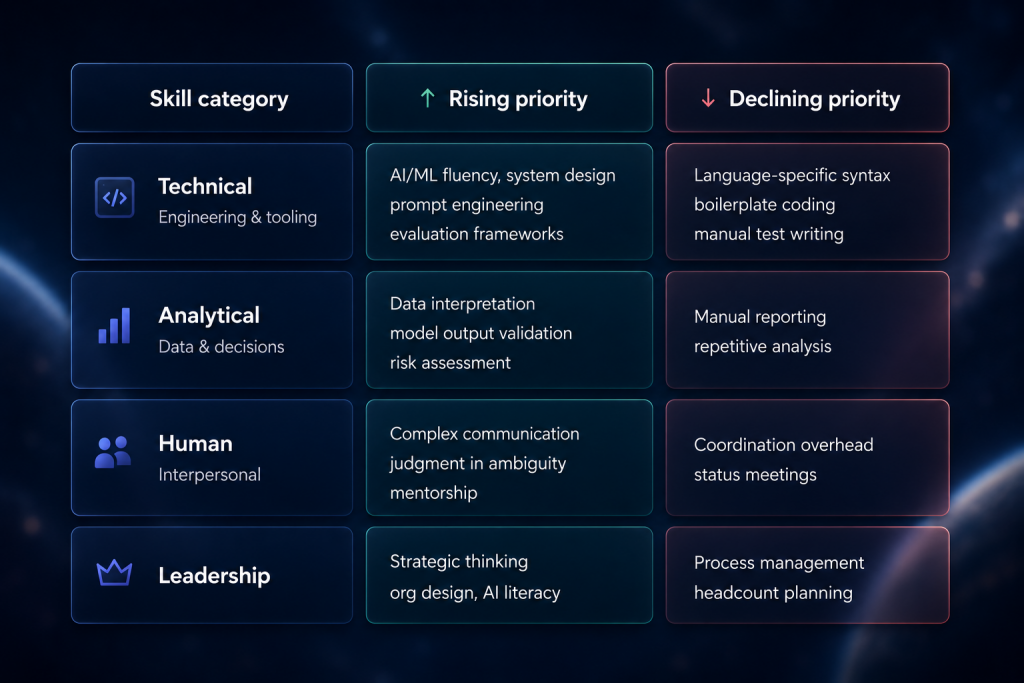
The World Economic Forum notes that 33% of developers rank GenAI and AI/ML as their top learning priorities for 2026. The bottom-up drive is real. Companies that create space for self-directed upskilling (peer-led learning communities, internal AI guilds, dedicated experimentation time) are turning individual initiative into organizational capability.
A Practical Case: What Restructuring Actually Looks Like
Consider a mid-size product team that historically ran with 10 people: 1 PM, 1 tech lead, 4 developers, 2 QA engineers, 1 DevOps, 1 scrum master.
In an AI-first restructuring, that same team’s output is achievable with a pod of 4–5: a senior engineer serving as AI orchestrator, a product lead with AI literacy, a specialist focused on data and integration quality, and a QA engineer focused on validation strategy rather than test execution. The scrum master function distributes across the group or is handled by lightweight AI tooling.
The output doesn’t decrease. What decreases is the volume of low-leverage human work — and what increases is the quality of the high-leverage decisions made by a smaller, more focused group.
The key word is restructuring, not headcount reduction as a goal. The teams getting this right are redesigning workflows first, then figuring out what that means for people. The ones getting it wrong are cutting first and asking questions later.
What JetSoftPro Is Seeing and Recommending
Across our client work in software development, AI-native product engineering, and intelligence transformation, a few consistent patterns stand out:
1. The AI skill gap is wider than most leaders think. The tools are widely adopted; the deeper capabilities — evaluating model output, designing feedback loops, and understanding when AI is confidently wrong — are not. This is where the real investment is needed.
2. Documentation and knowledge architecture are suddenly strategic. Teams building AI assistants and internal copilots quickly discover that the quality of their knowledge sources bounds the quality of their outputs. Unstructured, outdated, or poorly organized internal knowledge produces poor AI outputs. Companies that have invested in clean, structured knowledge are getting dramatically better results.
3. The “AI-first team” question is really an organizational design question. It’s not primarily about which tools you adopt. It’s about how you define roles, set expectations, build career paths, and make decisions. The companies navigating this well are treating it as a leadership challenge, not an engineering one.
4. Hybrid models — internal senior talent paired with AI-augmented external delivery — are becoming a standard pattern. The economic case is clear. The execution challenge is establishing the right governance, quality expectations, and knowledge transfer structures.
What to Prepare For Next
The horizon through 2027–2028 is where the picture gets significantly more complex. Autonomous AI agents — systems that can plan, act, and iterate across multi-step tasks with minimal human instruction — are moving from pilot to deployment. Deloitte estimates that 50% of organizations using generative AI will have launched agentic AI pilots by 2027.
That changes the calculus again. Human-in-the-loop becomes less about reviewing every output and more about designing the systems, setting the boundaries, and intervening at inflection points. The “AI orchestrator” role expands. The definition of what counts as human work contracts further.
Gartner projects that by 2028, AI will create more jobs than it destroys — but those jobs look different, require different skills, and sit in different places in the org chart. The 78 million net new positions the WEF projects by 2030 will not be distributed evenly or automatically. They will go to organizations and individuals who are actively preparing now.
The teams that will be in the best position are not the ones racing to cut headcount today. They are the ones investing in the human capabilities — judgment, architectural thinking, relationship intelligence, AI literacy — that compound in value as AI handles more of the execution layer.
At JetSoftPro, we partner with companies navigating this transition — from AI strategy and team structure advisory to AI-native product engineering and intelligence transformation. If you’re rethinking how your team is built for the AI era, let’s talk.