The 2026 World Cup ended yesterday. 48 teams, 104 matches, 16 stadiums across three countries, and more than five million fans in attendance. And AI at the World Cup 2026 was everywhere, running underneath all of it as the largest live deployment of machine learning in the history of sports
Most fans never noticed, which is exactly the point.
The best technology at this tournament wasn’t the kind you see. It was the kind that makes a controversial offside call understandable in four seconds, spots crowd congestion before it becomes dangerous, and gives the smallest football federation in the tournament the same analytics firepower as Brazil or France.
At JetSoftPro, we build AI-native systems for a living. So we spent the tournament watching the infrastructure as much as the football. Here’s the technical breakdown of what actually ran AI at the World Cup 2026, and what any engineering team can learn from it.
The offside system: how AI at the World Cup 2026 combined computer vision, a 500Hz sensor, and 1,248 digital twins
Start with the most visible piece — the one that decided actual match outcomes.
Semi-automated offside technology (SAOT) at the 2026 World Cup combined calibrated stadium cameras, skeletal tracking, a 500Hz sensor package inside the adidas Trionda match ball, and player-specific 3D models — all feeding a centralized video review workflow.
Let’s unpack that stack, because each layer is doing serious engineering work.
- The optical layer. 16 high-resolution tracking cameras per stadium, up from 12 in Qatar 2022, tracking up to 29 data points on every player, multiple times per second. This is production computer vision at scale — skeletal tracking across 22 fast-moving, frequently occluded bodies, in real time, with decisions that affect World Cup results riding on the output.
- The sensor layer. The adidas Trionda ball carries a 500Hz motion sensor — an inertial measurement unit with accelerometer and gyroscope — transmitting real-time motion data to the VAR system. Its job: identify the exact instant of ball contact. Not roughly when the pass happened. The precise frame. Because offside is judged at the moment the ball is kicked, and a few milliseconds of uncertainty can flip a decision.
- The digital twin layer. This is the 2026 innovation. Every one of the 1,248 players in the tournament was 3D-scanned before it began — a one-second full-body scan capturing precise body-part dimensions. 28 scanning booths were deployed to create the avatars.
Read: AI Integration in Software Development: 8 Signs It’s Actually Working
Why does this matter technically? Because previous SAOT systems estimated player geometry from camera data alone, and estimation produces errors exactly where it hurts most: fast movements, obstructed views, and marginal calls. Building from real scan data rather than camera estimation means the model matches what the camera sees, eliminating the class of controversy in which the offside graphic appears to show something different from the TV picture.
The result on screen: when Colombia’s Davinson Sánchez had a stoppage-time goal ruled out against Portugal, the broadcast showed his own 3D avatar offside, by the literal front of his boot. Fans disagreed with the outcome. Nobody disagreed with what they were seeing.
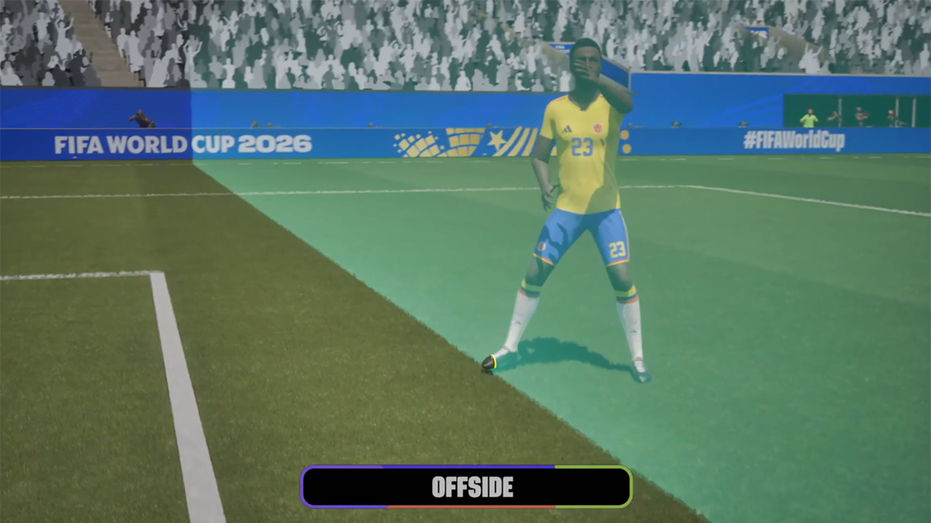
That’s the engineering lesson: the hardest problem was making the decision legible. A correct call that nobody understands is still a trust failure.
Football AI Pro: a domain-specific language model for 48 teams
The most interesting system at the tournament wasn’t on the pitch at all.
Football AI Pro is a generative AI knowledge assistant built on FIFA’s Football Language model, trained on hundreds of millions of data points from decades of FIFA competitions. It analyzes over 2,000 performance metrics and delivers insights as text, video clips, graphs, and 3D tactical visualizations in multiple languages.
Three engineering decisions here are worth studying:
- It’s a domain model, not a general one. FIFA didn’t point a general-purpose LLM at football data. They built on a Football Language model — a system trained specifically on football event data, tactical patterns, and match context. This is the pattern we see winning across industries in 2026: domain-specific models grounded in proprietary data outperform general models with clever prompting, every time the stakes are real.
- It’s deliberately scoped. The tool works before and after matches but not during live play. That’s not a technical limitation. It’s a governance decision about where AI belongs in a competitive environment. Someone drew a clear boundary around autonomous AI influence on live competition. More enterprise AI deployments need exactly this discipline.
- It levels the field by design. All 48 teams got equal access, democratizing analytics that were previously limited to federations with the biggest budgets. Advanced tactical analysis in every team’s own language. The strategic implication is bigger than football: when the tooling becomes equally available, the competitive edge shifts back to how well you use it.
Referee View: real-time AI video stabilization at broadcast quality
A small feature with a hard technical problem behind it. Referees wore body cameras throughout the tournament, and their first-person view was broadcast live. The problem with body-cam footage has always been physics: a running referee produces footage that’s unwatchable — motion blur, camera shake, rapid perspective changes.
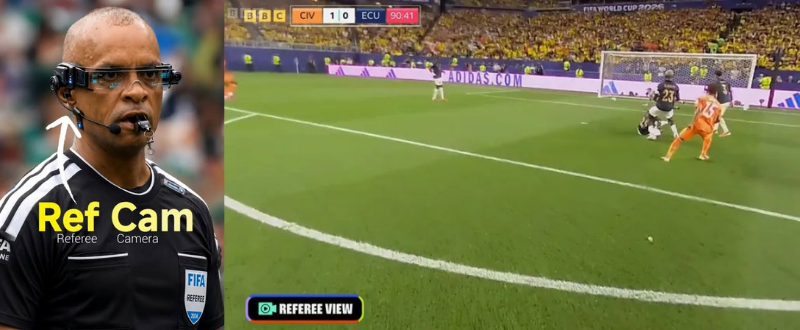
The 2026 Referee View used AI-powered stabilization software to smooth that footage in real time, eliminating motion blur as it happened, not in post-production. Real-time video enhancement at broadcast quality, on live footage from an unpredictably moving source, with millions watching.
Fans ranked the Refcam among the biggest success stories of the tournament. It also produced one of the tournament’s quiet cultural shifts: when viewers literally see what the referee sees, arguments about “how could he miss that” change character. Transparency infrastructure, disguised as a broadcast feature.
The invisible layer: digital twins, command centers, and crowd intelligence
The systems fans never saw were arguably doing the heaviest lifting.
- Digital twins of all 16 stadiums. Lenovo ran live digital twin models of every venue for crowd and security management — virtual replicas continuously updated with real-world data, letting operations teams simulate and monitor crowd flow, congestion, and emergency scenarios.
- An Intelligent Command Center across the whole tournament. It connected data across matches, venues, and broadcasters, monitored all operations in real time, and generated AI-powered daily summaries, helping security teams anticipate congestion before it became a safety issue. Note the design goal: not “collect all the data” but anticipate before escalation. That’s the difference between monitoring and intelligence.
- Smart wayfinding for five million fans. Interactive real-time maps guided fans to seats, water stations, and local landmarks — with live concession and bathroom queue information. Mundane? Completely. Also, exactly the kind of AI application that produces measurable satisfaction gains, because it solves a problem every single attendee actually has.
- Broadcast infrastructure. IPTV latency was brought under five seconds, with match content ingested, processed, and distributed in near real-time across ten channels to over 1,000 screens throughout FIFA venues.
⚠️ The dark side nobody puts in the press releases
The same AI wave that powered the tournament powered the attacks on it. Fortinet reported more than 13,000 World Cup 2026-themed domains registered between January and May 2026 alone, phishing infrastructure targeting fans at scale. Every high-visibility AI deployment now comes with an AI-powered threat landscape attached. Security architecture isn’t a parallel workstream anymore. It’s part of the product.
Why this was the hardest kind of AI engineering, and what the tournament actually proved
It’s worth pausing on what made this deployment technically hard. Not “AI is complicated” hard — specifically hard, in ways that most enterprise AI never has to face.
The synchronization problem
The offside decision depends on fusing two data streams running at completely different rates: optical tracking at roughly 50 frames per second, and the ball’s inertial sensor at 500Hz. The kick moment detected by the IMU almost never lands exactly on a camera frame. That means the system has to interpolate player positions between frames to reconstruct where every limb was at the precise millisecond of ball contact. Get the temporal alignment wrong by two frames — 40 milliseconds — and a sprinting player has moved roughly 30 centimeters. That’s the difference between onside and offside. The entire system’s credibility rests on solving a clock-synchronization and interpolation problem that most engineers never think about.
The occlusion problem
Skeletal tracking is a solved problem on a benchmark dataset. It is not a solved problem when ten bodies collapse into a penalty-box scramble and half the tracked joints disappear from every camera angle at once. This is where the pre-tournament 3D scans earn their keep: when optical data goes ambiguous, the system constrains its estimates with known body geometry — this player’s shin is exactly this long, so his boot can only be here. It’s a classic engineering pattern: when your sensor fails, prior knowledge fills the gap. The scan data isn’t decoration. It’s the fallback layer.
The latency budget
Every component — capture, inference, fusion, 3D render, broadcast delivery — has to complete inside a window short enough that the referee’s earpiece alert feels instant and the stadium graphic arrives while fans are still holding their breath. This forces edge computing decisions: which inference runs on-site in the stadium, what gets compressed before transmission, what can tolerate a round-trip to a data center. IPTV latency under five seconds across 1,000+ screens isn’t a vanity metric — it’s the visible output of hundreds of latency-budget decisions stacked end to end.
Why this matters beyond football
Strip away the pitch, and every one of these problems has a direct enterprise equivalent:
- Multi-rate sensor fusion is the core challenge in industrial quality control (high-speed line cameras + vibration sensors), logistics (GPS + accelerometer + RFID), and predictive maintenance. If your factory fuses a 10Hz temperature sensor with a 1kHz vibration stream, you’re solving the World Cup’s synchronization problem at different numbers.
- Prior-constrained estimation — using known geometry to survive noisy sensor data — is exactly how warehouse robotics handles occluded shelf views and how medical imaging pipelines stabilize measurements across scans.
- Digital twins with live data feeds moved from marketing slide to operational tool at this tournament. The same architecture runs crowd management in airports, load balancing in energy grids, and capacity planning in hospitals — anywhere a physical system is too expensive to experiment on directly.
- Domain-specific language models over proprietary data — the Football AI Pro pattern — is the highest-leverage enterprise AI play of 2026. Every organization with decades of structured operational data (claims, tickets, maintenance logs, transactions) is sitting on its own “Football Language model” that nobody has built yet.
The tournament, in other words, was a public stress test of the exact architecture patterns that enterprise AI runs on, at a scale and stake level no pilot project could simulate. Five million on-site users. Zero tolerance for downtime. Decisions broadcast to a billion people in real time. If you want evidence that these patterns hold up in production, it doesn’t get more public than this.
What an engineering team should take from AI at the World Cup 2026
Strip away the football, and the 2026 World Cup was a masterclass in production AI architecture. Five patterns stand out:
- Sensor fusion beats any single source. The offside system works because optical tracking, inertial sensors, and scan-based models cross-validate each other. No single data source was trusted alone. That’s how high-stakes AI should be built everywhere.
- Legibility is a feature, not a nice-to-have. The 3D avatars exist because accurate decisions that people can’t understand still destroy trust. If your AI makes consequential decisions, the explanation layer deserves as much engineering as the decision layer.
- Domain models grounded in proprietary data win. Football AI Pro is built on FIFA’s own decades of structured competition data. Your organization’s equivalent, whatever domain you’re in, is the moat.
- Scope AI deliberately, and say where it stops. No live-match AI assistance. Human referees as the final authority. Clear boundaries made the system trustworthy. Ambiguity about what the AI is allowed to do would have poisoned all of it.
- The invisible systems carry the event. Nobody tweeted about the command center or the digital twins. They just experienced a tournament where things worked. The highest compliment infrastructure can receive is silence.
Read: The End of “Cheap Outsourcing”: Why Choosing the Right Software Development Partner Is Now a Strategic Decision
What we see from the engineering side
At JetSoftPro, we’ve spent the last few years building AI-native systems, and the World Cup deployment validates a pattern we see constantly: the difference between AI that works in production and AI that works in demos is architecture.
Every system described above — sensor fusion, digital twins, domain-specific models, real-time processing at scale — is built from components that are available to any serious engineering organization today. What made the World Cup deployment succeed wasn’t secret technology. It was disciplined integration: clear scopes, evaluation at every layer, fallback plans, and governance decided before launch rather than after the first incident.
That’s the real story of AI at the World Cup 2026. Not that the technology was futuristic, but that it was engineered like infrastructure, not like a feature.
From our experience, the clients who ask us “which model should we use?” are usually asking the wrong first question. The World Cup didn’t succeed because of a model. It succeeded because of everything built around the models. That’s where the engineering actually lives.
JetSoftPro builds AI-native software products and has been an engineering partner to companies across the US, UK, and EU for over 14 years. If you’re building AI systems that need to work when it matters — let’s talk.