In February 2026, the software sector lost close to a trillion dollars in market value. Reuters tracked an $830 billion decline across software and services stocks over six trading days, and the trigger was the rollout of advanced agentic plugin capabilities.
Investors were not repricing AI. They were repricing a much older assumption: that enterprise software needs a human sitting in front of a screen, clicking through a UI, moving intent from one system to the next.
That assumption held for twenty years. It’s why SaaS pricing is per seat, why onboarding and training were a moat, and why the dashboard was worth paying for. Once an agent can reach the same outcome by calling an API directly, the premium on the interface starts to look optional.
This is a market story on the surface. Underneath it is an architecture story, and that is the part worth understanding, because agentic AI architecture changes what sits where in the stack, and most teams discover this the expensive way.
Agentic AI architecture vs traditional SaaS: two execution models
Traditional SaaS moves in one direction, through layers that were designed decades apart but fit together predictably.
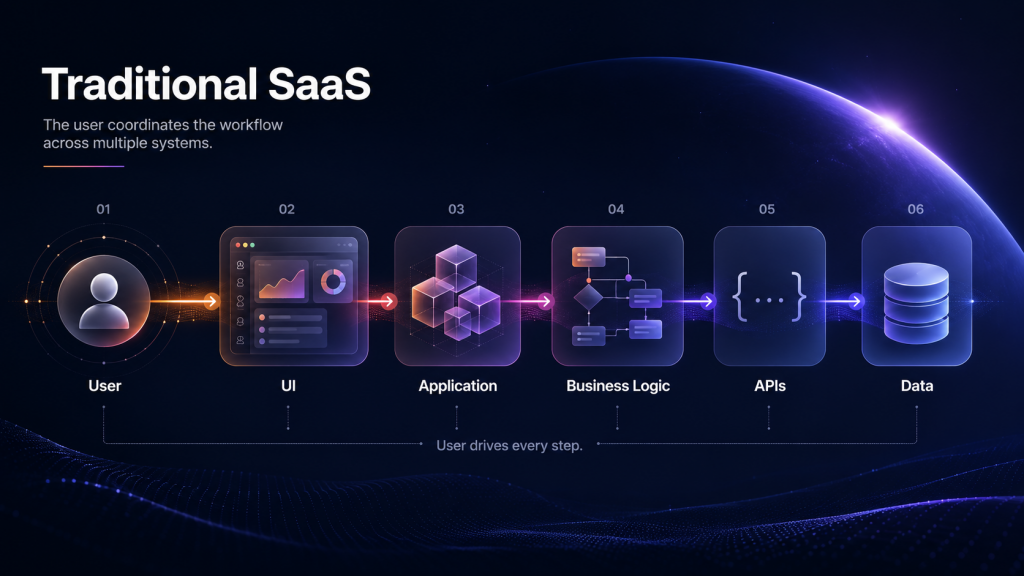
Every step is deterministic. The application knows what the business logic will do, the business logic knows which APIs it will call, and the sequence was decided at build time by a developer. What the system cannot do is decide anything new at run time. That job belongs to the person in front of the UI.
Agentic AI architecture rearranges this.
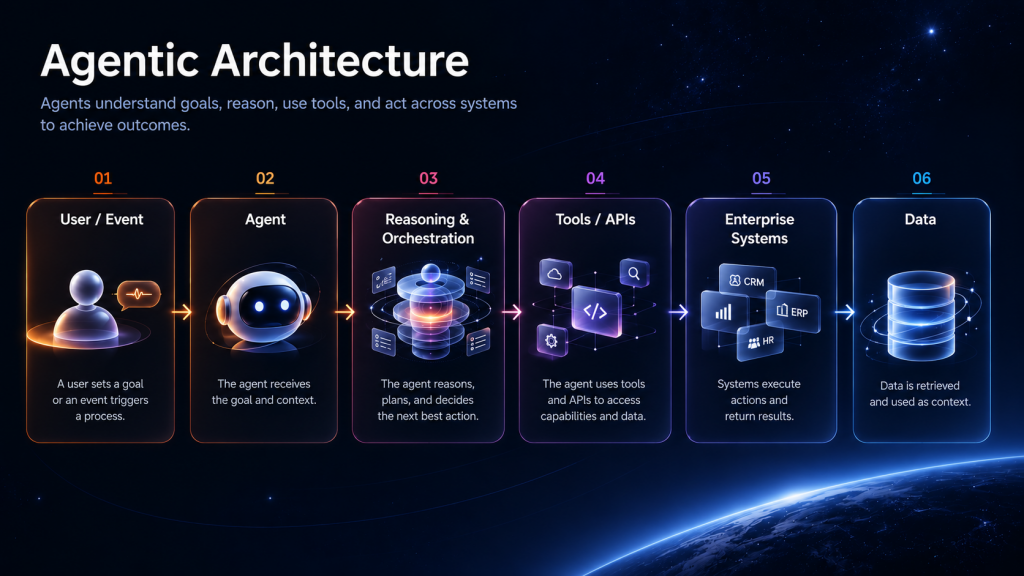
Two things changed. The entry point is no longer only a person, since an event can start the flow just as easily. And a reasoning layer now sits between the request and the systems, deciding which tools to call and in what order.
That second change is the whole shift. In traditional software, the human is the orchestrator, holding the context, deciding the sequence, carrying data between systems. In agentic AI architecture, that coordination moves into the system, and everything downstream has to be rebuilt around the fact that the caller is now a piece of software that reasons.
Read: Could You Pull the Plug? The AI Agent Governance Gap Nobody Planned For
How agentic AI architecture changes the software stack
Ten things move. Some are obvious, some only show up in production.
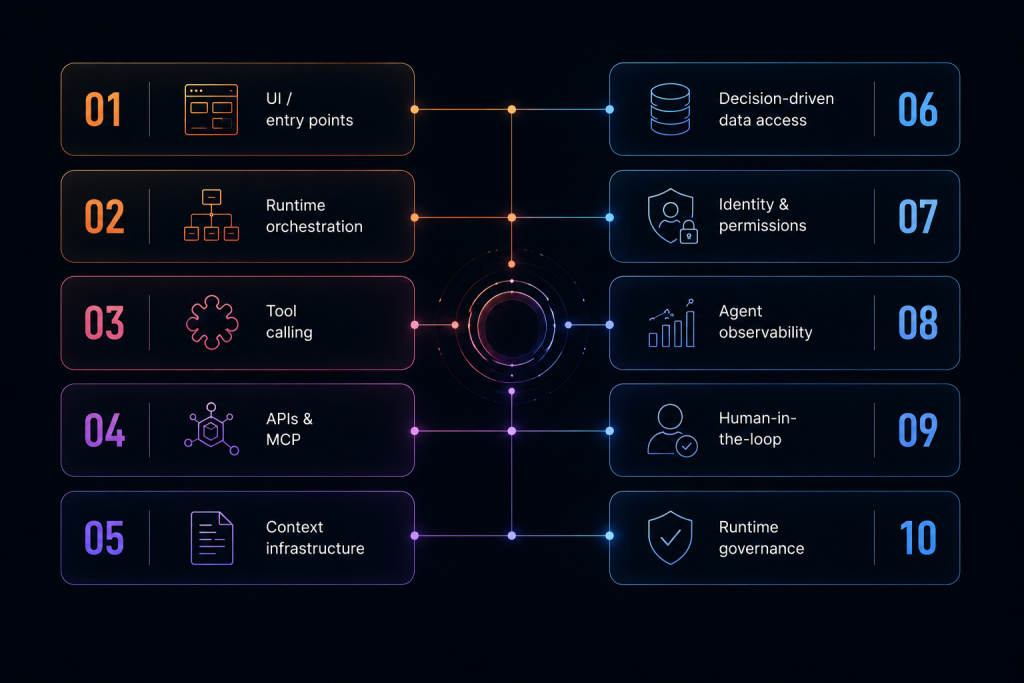
1. The UI stops being the control plane
In traditional SaaS, the interface is where intent enters the system, which makes it the control plane by default. Every action has a screen, every screen has permissions attached, and the audit trail is a record of what someone clicked.
In agentic AI architecture, the UI becomes one entry point among several. A request can arrive from a chat surface, a webhook, a scheduled job, or another agent. The interface is still useful, particularly for review and approval, though it is no longer the place where control is enforced.
The practical consequence catches teams out. If your permission model lives in the frontend, and many do, an agent calling the same backend bypasses it entirely. The control plane has to move down the stack before the agent arrives, not after.
2. Orchestration moves from build time to run time
A traditional workflow engine executes a sequence someone drew in advance. Step three always follows step two, and when the input falls outside the designed path, the workflow fails, and a person picks it up.
An agent decides the sequence while running. Given a goal, it selects tools, evaluates results, and adjusts. When something goes wrong, an agentic system is architected to notice and try a different approach, whereas a traditional pipeline simply stops.
That resilience has a price, and it is worth being honest about it. You gain adaptability, and you give up determinism. The same request can produce different execution paths on different days, which is fine for a research task and unacceptable for payroll. Deciding which of your workflows can tolerate that variance is an architecture decision, and it should be made deliberately rather than discovered later.
3. Tool calling replaces the integration layer
Integrations used to be code. A developer read the documentation, wrote a client, mapped the fields, handled the errors, and shipped it. Adding a new system meant another integration and another release.
In agentic AI architecture, a tool is a described capability. The agent receives a name, a description, a schema for inputs and outputs, and decides at runtime whether that tool is relevant to the goal in front of it.
This changes who your documentation is for. A tool description is no longer a note for a developer who will read it once, it is a runtime input that the model uses to make a decision on every call. Vague descriptions produce wrong tool selection, and wrong tool selection looks exactly like a model quality problem while actually being a documentation problem.
4. APIs become something an agent discovers, and MCP is how
A traditional API is consumed at build time. A developer reads the spec, decides which endpoints to use, and hard-codes the calls. The API can be inconsistent, badly named, and poorly documented, and the integration still works because a human absorbed the confusion once.
An agent reads the API at runtime, every time. Inconsistent naming, unclear parameters, and missing descriptions now produce failures in production rather than confusion during development.
This is the gap the Model Context Protocol is closing. MCP standardizes how agents discover tools, call them, and handle results, and it has moved quickly from an interesting idea to infrastructure. Anthropic donated it to the Linux Foundation, and the 2026 specification added a stateless core, support for long-running tasks, and enterprise-managed identity.
Two cautions worth carrying into a design review. MCP authorization is still optional in practice, according to NSA guidance issued in May 2026, and user identity does not always propagate end-to-end, which means a server can run on one shared credential set across every user. And the attack surface is real, since CVE-2025-6514, rated 9.6, allowed a malicious MCP server to execute operating system commands.
5. Context becomes infrastructure
In a traditional application, state lives in a session and a database, and it is structured because someone designed the schema.
An agent needs context that is assembled per decision, drawn from conversation history, retrieved documents, tool results, and system state, then fitted into a window that has a hard limit. What goes in, in what order, and what gets dropped when the window fills, all of it determines output quality more than model choice does.
Teams usually treat this as prompt engineering at first. It stops being prompt engineering the moment you have more than one agent and more than one data source, and it becomes an infrastructure concern with retrieval, ranking, caching, and eviction policies. The research literature has started calling this a scheduling problem, deciding which knowledge reaches which agent, from which source, in what order, which is a fair description of what it actually is.
6. Data access shifts from query per screen to retrieval per decision
Traditional applications query for a view. The customer detail screen pulls the customer record, the related orders, and the recent tickets, because a designer decided that is what the screen shows.
An agent queries for a decision, and it does not know in advance which fields it will need. That pushes work toward semantic retrieval, broader read scopes, and data that is described well enough for something to select from it without a human in the loop.
It also makes data quality a harder constraint than it was. A stale field on a dashboard is a minor annoyance, since the person reading it usually knows to distrust it. The same stale field feeding an agent decision produces a confident action based on something untrue.
7. Identity and permissions get genuinely difficult
This is the layer where most enterprise agent projects hit a wall.
Traditional access control has two clean categories. There are users, who authenticate and carry roles, and there are service accounts, which have fixed permissions and no ambiguity about who they are.
An agent’s behaviour is a hybrid of a user, an application, and a workflow. Sometimes it acts on behalf of a specific person and should inherit exactly that person’s permissions and nothing more. Sometimes it runs autonomously on a schedule with its own scoped rights. Often it does both inside one workflow, and the identity model needs to distinguish between those cases at every hop.
Most enterprise IAM has no concept of this. The result is the pattern you see everywhere in 2026, where an agent gets a broad service account because the alternative is a project nobody has budget for. That works until an auditor asks who authorized a specific action, and the honest answer is a shared credential.
Every protocol in this space handles authentication, and none of them handles fine-grained authorization at the granularity enterprise compliance needs. Role-based tool access, time-bounded capability leasing, and delegation chains with restrictions are all left to whoever is implementing. The same research is direct about the sequencing: implement authorization before exposing multi-agent capabilities, because retrofitting it onto a running system is considerably more painful than building it in.
8. Observability changes from logging requests to logging decisions
A traditional system logs what happened. Request in, response out, latency, status code. When something breaks, you trace the call chain and find the failure.
With agents, the call chain is only half the story. The other half is why the agent chose that path, which tools it considered, what context it had at the moment of the decision, and what it did when the first attempt failed. Reconstructing an incident without that is guesswork.
Enterprises currently have no standard way to surface what an agent did, when, and with whose authorization, and most teams are assembling custom logging and trace IDs. The emerging pattern puts a gateway between clients and servers, which makes it the one point that sees every tool call with the calling identity, session, parameters, response, latency, and timestamp, and exports it through OpenTelemetry into whatever SIEM the enterprise already runs.
There is a compliance deadline attached to this. Article 12 of the EU AI Act requires logging of the complete decision chain rather than output storage alone, with full enforcement from 2 August 2026.
9. Human in the loop becomes a component with a position
In traditional software, human review sits at the end. Someone approves the report, signs off the invoice, releases the deployment.
In agentic AI architecture, the review point is an architectural decision, and where you place it determines both the risk profile and whether the system is worth building at all. Review every action, and you have rebuilt manual work with extra steps. Review nothing, and you have an unbounded system. Review the right actions, meaning the irreversible ones and the ones crossing a value threshold, and the design holds.
The failure mode here is quiet. An approval workflow that fires forty times an hour stops being a control, because the person clicking approve is no longer reading. If a checkpoint exists, it needs a rate low enough that a human is genuinely evaluating; otherwise it is theatre that shows up in the audit log as diligence.
10. Governance moves into the runtime
Traditional governance is documentation and process. Policies, review boards, access request forms, quarterly audits.
Agents act faster than any of that. Governance that lives in a document is advisory, and governance that lives in the runtime is enforcement. In practice, that means guardrails checked at call time, budgets attached to agent identities, tool allowlists per role, circuit breakers that halt operation when thresholds are crossed, and a stop mechanism someone owns and has tested.
The design principle is straightforward. Anything you would want to prove to an auditor should be enforced in code, since anything enforced only in a policy document will eventually be bypassed by something moving faster than the policy.
What agentic systems still depend on
The list above is long enough to sound like everything is different, and that impression causes its own problems. Teams that believe agentic AI architecture replaces their stack start rebuilding things that were working, and they lose a year.
- Data quality still decides output quality, and the constraint gets sharper. In a traditional application, a stale or wrong field surfaces on a screen where a person usually catches it, since the account manager knows the renewal date moved last week even though the CRM still shows the old one. Remove that person, and the same field feeds a decision directly. The agent has no way to know the record is wrong, so it acts confidently on it, and the error propagates into whatever it does next. Every data problem you tolerated because humans were compensating for it becomes visible the moment agents start reading the same records.
- Enterprise systems remain the source of truth. An agent is a caller, not a database, and it should not be holding state that belongs in your systems of record. This sounds obvious and gets violated constantly, usually through memory layers that accumulate facts the agent has inferred, which then diverge from the underlying data. When they diverge, the system of record wins, and any architecture that makes that ambiguous will produce incidents that are very hard to debug.
- Deterministic processes should stay deterministic. Payroll runs, billing cycles, regulatory reports, and financial close all need to produce identical output from identical input, every time. Putting a reasoning layer inside them adds variance to a process whose entire value is the absence of variance. The useful pattern is to keep the deterministic core and let agents work at the edges, preparing inputs, investigating exceptions, drafting the commentary that goes around the numbers. The calculation itself stays in code.
- Security fundamentals do not get a new rulebook. Least privilege, network segmentation, secret rotation, and input validation all still apply, and agents make them more important because a compromised agent has broader reach than a compromised script. The shared credential pattern described earlier is not a new class of risk, it is an old one that agentic systems make easy to introduce at scale.
- Cost and latency are still engineering problems. Token spend behaves like any other variable cost, meaning it needs attribution, budgets, and alerts. A reasoning step that adds four seconds to a workflow is a design decision with a real user impact, the same as any other latency you would profile and optimise.
What all of this comes down to is that agentic AI architecture is additive. The APIs, the data layer, the identity provider, the observability pipeline, the deterministic workflows, all of it stays. What changes is that a new class of caller now uses those systems, and that caller has different requirements than the developer you originally designed them for.
Read: AI Integration in Software Development: 8 Signs It’s Actually Working
Where agentic AI architecture breaks down in practice
The adoption numbers show a gap between intent and execution. Gartner’s 2026 CIO and Technology Executive Survey found that only 17% of organizations have deployed AI agents, while more than 60% plan to within two years, which Gartner describes as the most aggressive adoption curve of any technology it currently tracks. McKinsey research puts the stall rate plainly, with 78% of companies having adopted generative AI, only 1% considering their strategy mature, and roughly 90% of high-impact use cases stuck at pilot stage.
The common thread in the projects that stall is that they were scoped as model problems. Which model, which framework, which prompt. Those questions matter, and they sit downstream of the ones that actually decide whether the thing ships.
There is a structural reason pilots mislead. A pilot usually runs with one or two users, a clean dataset someone prepared, a single system to integrate, and a developer watching every run. Every hard problem in the ten layers above is either absent or being absorbed by a human. Identity is simple because there is one user. Context is simple because there is one source. Observability is simple because the person who built it is reading the logs. The pilot succeeds, and it proves almost nothing about production.
Four failure patterns show up repeatedly once the same system meets real conditions.
- Permissions were never designed, so the agent got a service account. This is the most common one, and it usually happens under time pressure at the end of a pilot. The agent needs access to three systems; proper delegated identity is a quarter of the work nobody scheduled, and a broad service account unblocks the demo on Friday. It also removes any ability to answer who authorised a given action, and as covered above, retrofitting authorization onto a running multi-agent system is far harder than building it in at the start.
- A deterministic process was handed to a reasoning layer. Someone picks invoice processing or reconciliation as the first use case, because those are expensive and repetitive, which makes them look like ideal automation targets. They are ideal automation targets, and mostly for deterministic automation. The agent produces correct results in testing, then produces a slightly different interpretation of an edge case in month three, and finance loses confidence in the whole system. Choosing a first use case that tolerates variance matters more than choosing a good model.
- Nobody built an evaluation layer, so quality is measured by impression. Traditional software has tests that pass or fail. Agentic systems need something equivalent, meaning a fixed set of representative tasks, expected outcomes, and a way to detect when a model update or a prompt change degrades results. Without it, the only signal is user complaints, which arrive late and are hard to trace back to a cause.
- Tool descriptions were written as documentation rather than as runtime input. The team ships twelve tools with terse descriptions copied from internal API docs, the agent selects the wrong one on ambiguous requests, and the conclusion is that the model is not good enough. Rewriting the descriptions often fixes it. This is the cheapest problem on the list and one of the most frequently misdiagnosed.
The questions worth answering before writing code are consistent across all four. Where does the permission model live, and what identity does the agent carry at each hop. How is context assembled, and what gets dropped when the window fills. What happens when a tool call fails halfway through a multi-system update, and who reconciles the partial state. How will you know the output got worse. Who can stop this, and how fast.
None of those are model questions. All of them are architecture questions, and a team that has answered them can change models in an afternoon.
At JetSoftPro, we see agentic AI as an architecture challenge as much as an AI challenge.
The teams that get to production treat the agent as a new caller into an existing system, then work through what that caller needs at every layer it touches. That work is unglamorous, and it is the difference between a demo and something you can run.
JetSoftPro builds AI-native software products and has been an engineering partner to companies across the US, UK, and EU for over 20 years. If you are working out how agentic AI architecture fits into systems you already run, let’s talk.