Somewhere in your company, an agent is running right now, and it is a good test of how far your AI agent governance actually goes. It has database credentials, can call internal APIs, and executes on a schedule that someone set up three weeks ago. It works well enough that nobody has looked at it since.
Now ask a simple question: if that agent started doing something wrong at 2 am on a Saturday, who stops it, and how long would that take?
Most companies cannot answer this. According to Writer’s 2026 enterprise AI survey, 35% of executives admit they could not immediately pull the plug on a rogue AI agent, and 67% believe their company has already suffered a data leak or breach because of unapproved AI tools. The same survey found that 55% describe AI use inside their company as a chaotic free-for-all.
These numbers are not evidence that AI is dangerous. They describe a permissions and accountability problem that arrived faster than the controls built to handle it.
Why AI agent governance breaks the rules that worked for software
Traditional software governance rests on two assumptions, and agents violate both.
The first assumption is determinism. Given the same input, conventional software produces the same output, which means you can test it once and trust the result. An agent built on a language model produces variable output across runs, so a test that passed on Tuesday tells you less than you would like about Saturday.
The second assumption is that software acts when a human tells it to. An agent holds credentials and acts on its own schedule, inside workflows, across systems. It is closer to an employee with system access than to a script.
That shift changes what governance has to cover. You are no longer asking whether the code is correct. You are asking what this thing is allowed to touch, what it can do without asking, and who answers for it when the answer turns out to be wrong.
A concrete example makes the gap visible. A support agent with read access to a ticketing system is a low-stakes tool, and if it summarizes a ticket badly, someone notices and moves on. Give that same agent write access so it can update ticket status and send customer emails, and the failure mode changes completely. Now a misread instruction produces messages that already went out, to real customers, with your company name on them. The model did not get more dangerous. The permissions did.
Read: AI Integration in Software Development: 8 Signs It’s Actually Working
The binary trap that Gartner calls the root cause of failure
The instinct, once this risk becomes visible, is to lock everything down. That instinct causes its own failures.
Gartner predicts that by 2027, 40% of enterprises will demote or decommission autonomous AI agents because of governance gaps found only after a production incident. The diagnosis behind that number is the interesting part.
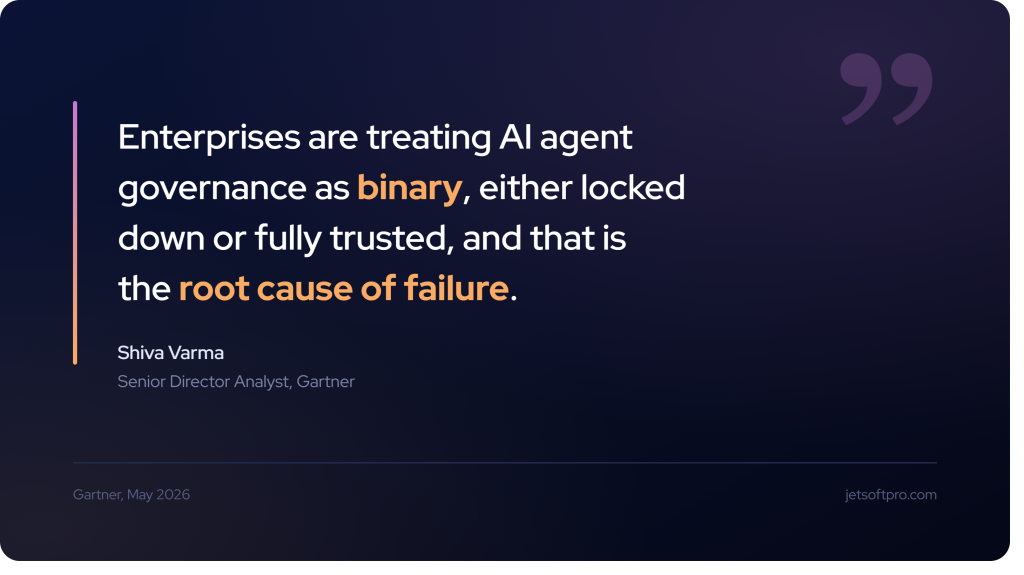
Gartner describes two failure modes that follow from uniform controls. Over-restriction of simple agents slows delivery and pushes developers into shadow projects, where the governance you built does not apply at all. Under-restriction of autonomous agents leaves security, compliance, and operational risk sitting in production, unnoticed until it is not.
Both failures come from the same mistake, which is applying one policy to every agent regardless of what that agent can actually do.
What proportional AI agent governance looks like
The alternative is to classify agents by autonomy level and match the controls to each level. Gartner sets out four, and they are worth walking through because the jump in required control between them is not gradual.
Level 1. Observe.
Read-only access to defined data sources; output visible only to the person who asked. Document summarization, knowledge retrieval, code explanation. Risk is limited to data exposure and output accuracy, so controls stay light: scoped access, authentication, usage logging, basic security testing.
Level 2. Advise.
The agent drafts, recommends, proposes, and a human executes. Still read-only, still no write access anywhere. The new risk here is subtle and worth naming, because automation bias means people trust confident output. Gartner’s guidance adds accuracy and hallucination testing, domain-specific quality evaluation, and training so users know how much to rely on it.
Level 3. Act with approval.
The agent writes data, sends communications, changes configurations, but only after a human approves each action. This level looks safe and often is not, because approval workflows degrade under time pressure. A reviewer clicking approve forty times an hour is not a control, they are a formality. What makes Level 3 real is audit trails on every approval, agent-specific incident response, and security testing that assumes the approval step will sometimes fail.
Level 4. Act autonomously.
The agent executes inside defined guardrails, and humans review exceptions and aggregate outcomes rather than individual decisions. Gartner is direct about what this level demands: continuous monitoring, enforced guardrails, rapid rollback, circuit breakers that halt operation when thresholds are crossed, and named ownership for agent behavior. Actions here happen faster than people can watch them, and accountability stays with the organization regardless.
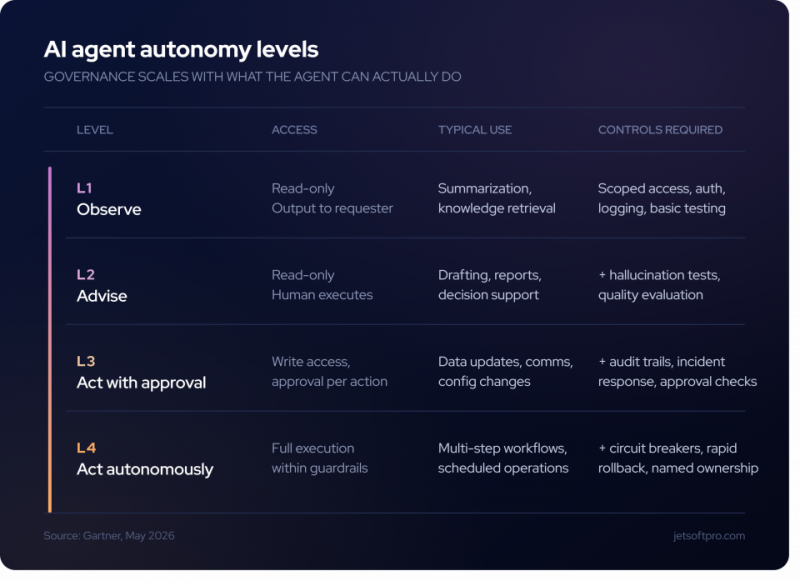
The practical value of this model is that it turns a vague question (is our AI agent governance good enough) into a specific one (which level is each agent at, and do the controls match). Most companies discover during that exercise that they have Level 3 permissions running under Level 1 controls.
The kill switch nobody has tested
Circuit breakers and rollback show up in Gartner’s Level 4 requirements, and they are the part teams most often assume exists.
Three questions settle it quickly. Who has the authority to stop every agent in production right now? How long does it take from decision to full stop? When did anyone last test it?
In our experience, the third question is the one that produces silence. A kill switch documented in a runbook and never executed is a hypothesis, not a control. The pattern here is the same as disaster recovery, where the backup that has never been restored is not a backup, and teams learn this during the incident rather than before it.
Worth checking alongside it: whether stopping an agent mid-task leaves your data in a consistent state. An agent halted between step three and step four of a multi-system update has left something half-finished. Somebody needs to know what.
Read: What “AI-First” Really Means at the Architecture Level
The compliance clock for AI agent governance is already running
The regulatory timeline removes the option of treating this as a next-year problem.
The EU AI Act carries penalties of up to €35 million or 7% of global turnover for prohibited AI practices, and August 2026 is the point where enterprises can no longer treat AI governance as a future concern. Member states were required to establish AI regulatory sandboxes by this month, which shifts the standard from claiming compliance to demonstrating it through supervised testing.
The readiness gap against that timeline is wide. Deloitte finds 74% of organizations plan to adopt agentic AI within two years, while only 21% currently have a mature governance model for AI agents. Writer’s survey adds that 36% of organizations have no formal plan for supervising AI agents at all.
For regulated industries, the numbers get sharper. 73% of healthcare AI agent deployments fail HIPAA compliance because standard AI architectures violate Technical Safeguards requirements, with potential fines of $1.5 million per violation and breach costs averaging $7.42 million. The architecture that works fine for an internal tool does not survive contact with a compliance auditor.
Where to start if you have agents in production today
Three steps, in this order, because each one depends on the last.
- Inventory what is actually running. Not what was approved; what is running. 79% of organizations report AI applications being created in silos, which means the list you have is shorter than the list that exists. Ask every team what they have deployed, and expect surprises. This exercise is uncomfortable, and it is also the only way to govern something you do not yet know about.
- Map permissions against autonomy level. For each agent, write down what it can read, what it can write, and what it can trigger. Then place it on the four levels above. The mismatches are usually obvious once written down, and they are almost always in the direction of more access than the controls assume.
- Test the stop. Pick your highest-autonomy agent, decide who owns shutting it down, and run the drill. Time it. Find out what breaks. Fix that, then document what you learned rather than what you intended.
None of these steps require new tooling, and all three can be done in a week by a team that decides to do them.
What we see at JetSoftPro about AI agent governance
The clients who handle this well built governance into the pilot, and it cost them a few days at the start. The clients who retrofitted it after an incident spent considerably more, usually while under pressure from a board that had just discovered the problem existed.
There is a second pattern worth naming. Teams that treat governance as a compliance exercise produce documents. Teams that treat it as an architecture decision produce systems where the constraints are enforced in code, which is the version that holds when someone is moving fast on a Friday afternoon.
Governance designed in advance is boring and cheap. Governance designed during an incident is neither.
From our experience: When a client asks us to review an existing agent deployment, the first thing we ask for is the permission scope, not the prompt. The prompt tells you what the agent was meant to do. The permissions tell you what it can actually do, and the gap between those two is where the incidents live.
JetSoftPro builds AI-native software products and has been an engineering partner to companies across the US, UK, and EU for over 20 years. If you have agents in production and want an honest read on your AI agent governance before an auditor gives you one, let’s talk.