Almost every company in 2026 will tell you they’re doing AI integration in software development. Most of them are right. But there’s a difference between a team that added AI to their product and a team that built their product around AI.
One is a renovation. The other is a different kind of building. And the gap between the two shows up not in demos or pitch decks; it shows up in delivery speed, in system reliability, in how fast a team can respond when something breaks.
80% of AI projects fail to deliver measurable business value, according to RAND Corporation’s analysis of 2,400+ enterprise AI initiatives. 95% of generative AI pilots show zero return on the P&L statement, per MIT Project NANDA.
The teams that land in the successful 5% are not using better tools. They’re doing AI integration in software development differently — at the architecture level, not just the feature level.
Here’s how to tell which side you’re on.
The Difference That Actually Matters in AI Integration in Software Development
An AI-augmented product adds AI features to an existing architecture. A chatbot bolted onto a CRM. A summary button was added to a document system. A recommendation widget dropped into an e-commerce flow.
These things can be useful. They’re just not AI integration in software development in any meaningful sense.
An AI-native application is designed from the ground up with AI in the critical path. The data model, the API structure, the fallback logic, the evaluation layer — all of it built with the assumption that AI is doing real work, not decorating the interface.
The difference matters because retrofitting is painful and expensive. McKinsey analyzed nearly 300 companies and found that the ones unlocking real value from AI are those that rearchitect how they build software, not those that add tools to existing workflows.
So before we get to the checklist: which type of product are you building?
Read: Who Writes the Code? A Practical Guide to Agentic AI in Software Development
8 signs your AI integration in software development is actually working
1. Remove the AI, and the product breaks
This is the clearest test.
If you could strip out the AI layer and the product still works — just slower, or with fewer features — that’s an add-on. The AI is optional. It’s decoration.
In a product with real AI integration in software development, removing the AI doesn’t degrade the experience. It breaks the core functionality. The product was designed around it, not draped over it.
Ask your team: what breaks if the model goes down? If the answer is “not much,” that’s your answer.
2. Your Data Layer Was Built for AI Integration in Software Development, not retrofitted to support it
85% of failed AI projects cite poor data quality as a root cause. Only 12% of organizations have data of sufficient quality to support AI applications, according to Gartner’s 2025 research.
That’s an architecture problem. Real AI integration in software development starts at the data layer — how data is captured, structured, labeled, and fed to models. Not as an afterthought in sprint 12, but as a design decision in week one.
If your data team is constantly scrambling to clean data so the AI feature can run, you’re retrofitting. If the data pipeline was built with the AI’s requirements in mind from the start, you’re not.
3. You have an evaluation framework, not just vibes
Only 28% of AI use cases fully succeed and meet ROI expectations, according to Gartner’s survey of 782 infrastructure and operations leaders. A major reason: teams measure AI adoption, not AI output quality.
Serious AI integration in software development means having a systematic way to evaluate what the AI produces. Not “does it seem right?” but:
- Does it pass tests written independently of the model?
- Does output quality hold after a model update?
- What’s the error rate on edge cases?
- How do you catch regressions before users do?
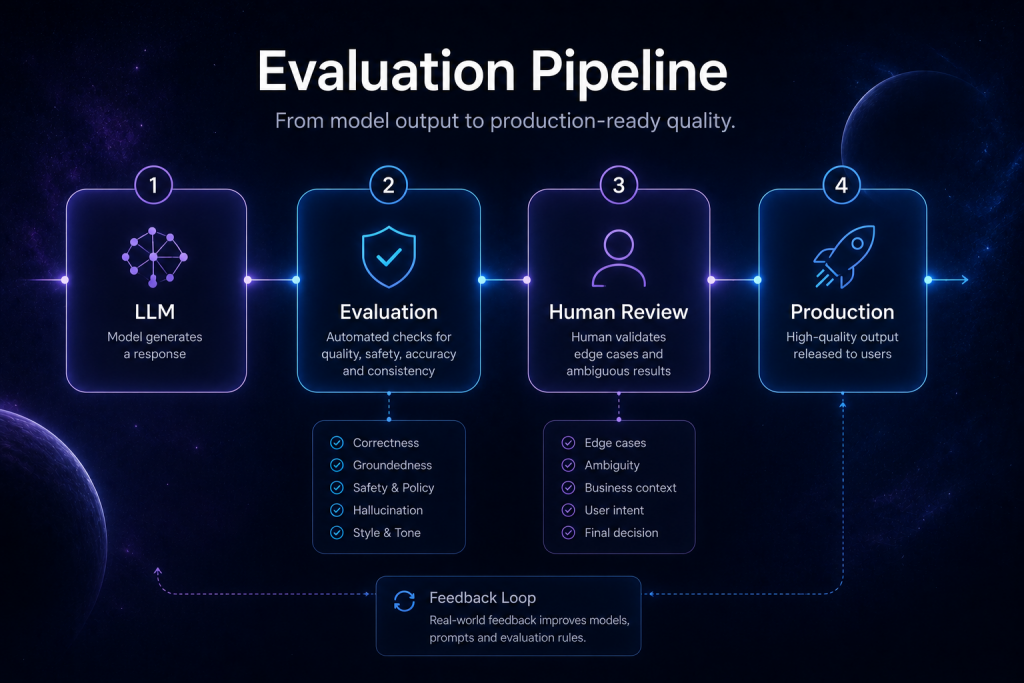
Serious teams have evaluation pipelines and observability into their AI systems. Amateur teams ship prompts and hope.
If there’s no evaluation layer, there’s no real AI integration. There’s just hope at scale.
4. Fallback logic exists, and someone has tested it
Models fail. APIs go down. Context windows overflow. Inference costs spike.
A product with solid AI integration in software development plans for all of this before it happens. What does the user experience look like when the model is unavailable? Does the product degrade gracefully, or does it just break?
This is core architecture, not edge-case handling. AI-native applications need fallback logic built in from the start, not patched in after the first production incident.
If your team has never run a “what if the model is down?” scenario, the fallback logic hasn’t been tested. Which usually means it doesn’t really work.
5. AI cost is a product metric, tracked like any other
MCP token costs can run 160x higher than equivalent CLI operations. Inference costs scale with usage in ways that surprise most teams who didn’t plan for them.
In a product where AI integration in software development is taken seriously, inference cost per user, per workflow, per feature is on a dashboard somewhere. It’s tracked. It’s reviewed. It informs product decisions, which features to scale, which to rethink, and where to optimize the prompt.
If nobody on your team knows what your AI features cost to run at current scale — let alone at 10x — the integration was built without the infrastructure to operate it.
6. Your AI gets better in production, not just in retraining cycles
A static model with a static prompt that never changes is a feature. It may be a useful feature. But it’s not AI integration in software development in the sense that matters.
Real integration means there’s a feedback loop. User corrections, behavioral signals, new data — all of it flowing back in ways that improve model output over time, without requiring a full rebuild.
This doesn’t have to be complex. But it has to exist. If your AI was deployed six months ago and produces exactly the same quality output it did on launch day — regardless of everything that’s happened since — it’s not integrated. It’s installed.
7. Governance is part of the architecture, not a conversation for later
Only 21% of companies globally have a mature governance model for AI agents, according to Deloitte. That means most organizations deploying AI don’t know clearly: what decisions does the AI make autonomously? What data does it touch? Who is accountable when it’s wrong?
73% of failed AI projects had no agreed definition of success before the project started. 61% were approved on projected ROI that was never measured after launch, per MIT Sloan.
Governance for AI integration in software development means: knowing what the AI is allowed to do, designing the system so it can only do those things, and having a clear answer to “who owns this when something goes wrong?” — before something goes wrong.
If governance is still a pending conversation on your roadmap, that’s worth stopping for.
8. Your roadmap is shaped by AI capability
This one is the hardest to assess from the outside and the most telling.
In a product where AI integration in software development is genuinely foundational, AI isn’t something that gets considered when a feature is already half-designed. It’s been in the room from the beginning. “How does AI change what’s possible here?” is a question asked at the concept stage, not the implementation stage.
Teams doing this well don’t ask “can we add AI to this feature?” They ask “what does this feature look like if AI is part of how it works?” That’s a different question, and it produces different products.
If your product roadmap reviews don’t include a standing conversation about AI capability, AI is a feature on your product. It’s not the foundation.
What the numbers say about where most teams actually are
88% of organizations use AI somewhere. Only 16% have scaled AI across the enterprise, per IBM’s CEO study. Only 25% of AI initiatives have delivered expected ROI.
The gap between those numbers is not a technology gap. It’s an integration gap.
⚠️ The pattern behind the failures with AI integration is software development
RAND’s root-cause analysis of 2,400+ enterprise AI initiatives points to the same recurring problems: misaligned purpose, inadequate data foundations, infrastructure and integration gaps, and chasing the technology rather than the business outcome. The technology usually works. Leadership creates the conditions for success or failure.
Scored yourself 3 out of 8 on the checklist above? Most teams aren’t at 8. The ones who think they are usually haven’t tested their fallback logic or looked at their inference costs.
Read: The End of “Cheap Outsourcing”: Why Choosing the Right Software Development Partner Is Now a Strategic Decision
Where to Start With AI Integration in Software Development
Three things move the needle more than anything else:
- Fix the data layer first. Everything downstream depends on it. Before adding new AI features, run an honest assessment of your data quality, structure, and pipeline. 60% of AI projects lacking AI-ready data will be abandoned through 2026, per Gartner. The ones that survive started by fixing this.
- Build the evaluation layer before you need it. It’s much harder to add after the fact. Decide now what “good” looks like for your AI outputs, how you’ll measure it, and what triggers a review. This single step separates teams that catch problems early from teams that discover them in production.
- Define governance before you scale. What decisions can your AI make without human approval? What data can it touch? Who’s accountable? These aren’t compliance questions — they’re architecture questions. Answer them while the system is still small enough to redesign.
What we see at JetSoftPro
After 20 years of building software and the last few building it with AI at the core, we’ve had both kinds of conversations.
The “how do we add AI to this?” conversation. And the “how does AI change what we’re building?” conversation.
They lead to very different places. The first produces features. The second produces products that are genuinely hard to compete with.
The clients we work with who get the most from AI integration in software development share one thing: they treated AI as an architectural decision, not a product feature. Everything else followed from that.
From our experience, these are the questions we ask at the start of every AI-native engagement because the gaps are where the real work is.
JetSoftPro builds AI-native software products and has been an engineering partner to companies across the US, UK, and EU for over 14 years. If you want an honest assessment of where your AI integration in software development actually stands — and what to do next — let’s talk.